
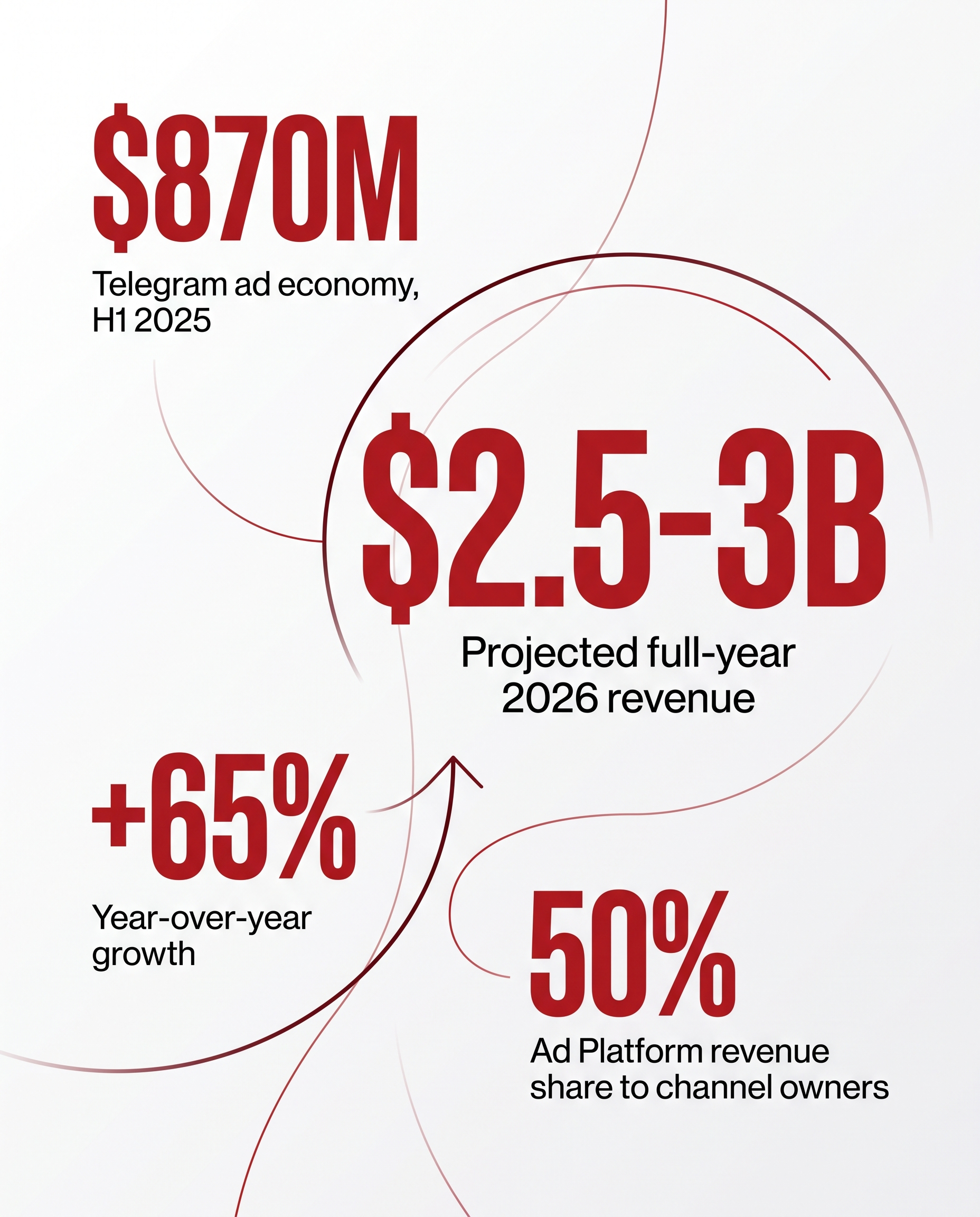
Telegram reported total company revenue of roughly $870 million for the first half of 2025 - a figure that spans Toncoin-related revenue (roughly $300 million), Telegram Premium subscriptions (roughly $223 million), and in-app advertising (roughly $125 million), not advertising revenue alone. Treat $870M as Telegram's whole-company H1 2025 revenue, and the roughly $125 million figure as the advertising-specific slice within it.
A meaningful share of Telegram's advertising and monetization revenue is built to flow to the people who actually built the audience: channel admins, bot developers, and Mini App owners.The TrafficSigma team analyzed every official and third-party monetization path currently open to Telegram publishers - the built-in Ad Platform, Telegram Stars, affiliate/CPA promotion, and third-party Mini App ad networks - to map out which one fits which kind of audience. This guide is written for channel, bot, and Mini App owners monetizing their own audience.
The four monetization models every Telegram owner should know
There's no single "best" way to monetize a Telegram presence - the right model depends on your format (channel vs. bot vs. Mini App), your audience size, and whether your content lends itself to ads, paid content, or commerce. Four distinct models cover almost every real monetization path available to Telegram publishers in 2026:
- Telegram's official Ad Platform: native, in-channel ads that Telegram itself sells and inserts between your posts, splitting the revenue with you automatically. This is the only model Telegram operates and pays out directly.
- Telegram Stars and paid content: a first-party digital currency that lets you charge subscribers directly for exclusive posts, bot features, or channel subscriptions - no advertiser or ad inventory required at all.
- Affiliate and CPA promotion: using your existing audience's trust to promote third-party offers (apps, casinos, trading platforms, subscription products) for a commission per install, deposit, or sale, independent of any Telegram-native payout system.
- Third-party ad networks for Mini Apps and smaller channels: external networks that plug ad inventory into properties Telegram's own Ad Platform doesn't reach - Mini Apps, bots, and channels below the official platform's subscriber floor.
Each model has a different audience-size floor, payout mechanism, and content fit - the sections below break down exactly how each one works, who qualifies, and what it actually pays.
Get iGaming traffic from TrafficSigma now!
Telegram's official Ad Platform: the built-in revenue-share model
Telegram's Ad Platform is the company's own in-house system: it sells sponsored messages to advertisers and inserts them between posts in eligible public channels, then pays a cut of that revenue - your Telegram channel ad revenue - straight back to the channel owner. It launched its revenue-sharing program in March 2024, and the mechanics have stayed stable through 2026. Think of this section as the core of any Telegram ads monetization guide, since it's the only payout model Telegram runs and pays out directly.
Eligibility. Your channel must be public (have a permanent t.me/ username, not just an invite link) and have at least 1,000 subscribers. There's no application or approval step beyond that threshold - ads begin appearing automatically once a channel qualifies and the owner opts in.
Revenue share. Telegram pays channel owners 50% of the ad revenue generated from ads shown in their channel. Payouts accrue in Toncoin (TON), the cryptocurrency of The Open Network, and are withdrawn through Fragment, Telegram's TON-based marketplace and payout rail, with no platform fees on the withdrawal itself.
How to enable it. From your channel, go to Settings → Statistics → Monetization, toggle ads on, and link a TON wallet through Fragment to receive payouts. You can also choose to reinvest earned TON directly into Telegram Ads, collectible usernames, or Telegram Premium gifting instead of cashing out - a meaningful option for admins actively growing their channel rather than extracting income from it.
Real economics. CPMs vary sharply by niche and GEO - finance, crypto, and tech channels consistently outearn general entertainment or meme channels per thousand views, and a channel's per-view payout in TON fluctuates with advertiser demand in that vertical. The practical implication: this model rewards channels that have already reached the 1,000-subscriber floor with an engaged, niche-specific audience - it's a passive layer on top of organic growth, not a strategy for channels still building their base.
| Requirement | Detail |
|---|---|
| Eligible property | Public channels only (permanent t.me/ username) |
| Minimum audience | 1,000 subscribers |
| Revenue share | 50% to the channel owner |
| Payout currency | Toncoin (TON) |
| Withdrawal route | Fragment, no platform fee |
| Setup path | Settings → Statistics → Monetization |
Telegram Stars: direct monetization without a subscriber floor
Telegram Stars, launched in June 2024, is Telegram's own in-app digital currency, purchased by users through Apple, Google, or Telegram's PremiumBot and spent inside the app on digital goods, bot features, channel subscriptions, and creator support. Unlike the Ad Platform, Stars has no minimum-subscriber requirement - it works for a brand-new channel or bot with a handful of followers just as well as a large one, which makes it the natural starting point for owners who haven't hit 1,000 subscribers yet.
How channels use it. Admins can gate individual posts behind a Stars paywall - followers see a preview or announcement in the free feed, and the full post unlocks only after paying in Stars - or set up a recurring Stars-based channel subscription for ongoing exclusive content, mixing free and paid material in the same channel without forcing every follower into a subscription.
How bots use it. Bot developers can charge Stars for digital products sold inside the bot itself - courses, e-books, premium features, in-game items, or access tiers - with the payment flow handled entirely by Telegram's native Stars API, so there's no separate payment processor to integrate for digital goods specifically.
Withdrawal mechanics. Stars earned from real user payments (not purchased Stars) can be converted to TON via Fragment once your balance passes 1,000 Stars, subject to a 21-day holding period from when each batch of Stars was received - a fraud-prevention window, not a platform fee. Face value runs roughly $0.013-$0.02 per Star, though the actual net after conversion typically lands around 75-88% of face value depending on the route and volume, and Apple/Google's standard 30% in-app-purchase cut applies when a user buys Stars on mobile (it doesn't apply to Fragment-side conversion of already-earned Stars).
Best fit. Stars suits creators with genuinely exclusive content worth paying for directly - a niche newsletter, a trading-signals channel, a course delivered via bot - rather than general-interest channels better served by ad revenue or promotional commissions.
| Requirement | Detail |
|---|---|
| Eligible property | Channels or bots, any audience size |
| Minimum audience | None |
| Use case | Paid posts, channel subscriptions, in-bot digital goods |
| Payout currency | TON (converted from Stars via Fragment) |
| Withdrawal threshold | 1,000 Stars, 21-day holding period per batch |
| Platform cut | ~0% from Telegram; Apple/Google take 30% on mobile Star purchases |
Start scaling your campaigns with TrafficSigma
Affiliate and CPA promotion: monetizing audience trust directly
Independent of anything Telegram itself pays out, channel and bot owners can monetize by promoting third-party offers to their audience under an affiliate or CPA (cost-per-action) arrangement - earning a fixed commission per install, signup, deposit, or sale rather than per ad impression. This is the oldest and, for many niche channels, still the highest-earning model, because it converts on trust rather than ad-inventory scale.
How it works in practice. A channel owner joins an affiliate program relevant to their niche (finance apps, VPNs, trading platforms, subscription software, sweepstakes and casino operators, dating apps), gets a tracked referral link or promo code, and posts native-feeling recommendations, tutorials, or "deal" posts to their audience. Payout structures range from a flat CPA per qualified action to a percentage revenue share (RevShare) on what the referred user spends over time - RevShare deals in high-payout verticals like iGaming commonly run in the 25-45% range of the referred player's net revenue, which can substantially outearn a one-time CPA payout for a channel with loyal, repeat-engaging followers.
Why it fits Telegram specifically. Channel and group formats are unusually well-suited to affiliate promotion because Telegram audiences are opted-in and high-trust by nature - a subscriber joined voluntarily and reads posts directly, without an algorithmic feed diluting reach the way it does on other platforms. That trust is exactly what converts affiliate offers at a higher rate than cold traffic.
Where to find offers. Niche-specific affiliate networks and individual brand affiliate programs both work; the key selection criteria are payout terms, GEO fit for your subscriber base, and whether the advertiser allows Telegram as a traffic source at all (some verticals restrict channel-based promotion in their terms - always confirm before running a campaign).
| Requirement | Detail |
|---|---|
| Eligible property | Any channel, bot, or group with an engaged audience |
| Minimum audience | None (trust density matters more than size) |
| Payout structure | Flat CPA per action, or RevShare (commonly 25-45% in iGaming) |
| Payout source | The affiliate program/network, not Telegram |
| Key risk | Verticals/advertisers may restrict Telegram as a traffic source |
Third-party ad networks: monetizing Mini Apps and smaller channels
Telegram's own Ad Platform only reaches public channels over the 1,000-subscriber threshold - it doesn't serve ads inside Mini Apps, bots, or smaller channels below that floor. That gap is filled by independent, third-party ad networks that plug directly into Mini App inventory and bot conversations, paying developers per impression or per click instead of waiting on Telegram's own revenue share.
Ad formats available. Mini App-focused networks typically offer banner placements, full-screen interstitials shown between game levels or app actions, and rewarded interstitials where the user opts in to watch an ad in exchange for an in-app bonus or currency. Rewarded formats consistently outperform forced placements - click-through rates on rewarded interstitials are commonly reported well above standard mobile display ads (unverified figures cite ranges as high as 20-40% versus 0.5-2%, though these aren't independently confirmed), because the user has already chosen to engage before the ad plays.
Typical rates. Published rates on at least one Mini App-focused network cluster around $0.015 per click for push-style ad units, roughly $0.40 CPM for standard banners, around $1.50 per 1,000 clicks for interstitials, and $3.00-$3.80 CPM for video and in-bot placement formats - these are near-identical to one vendor's published pricing rather than an industry-wide average, and figures vary by GEO, vertical, and network, so confirm current rates directly with whichever network you're evaluating rather than treating this as a fixed benchmark.
Where TrafficSigma fits for Mini App owners. If you own a Telegram Mini App - a game, utility, or tool built on Telegram's Mini App platform - TrafficSigma's ad network runs Telegram Mini App ad placements as one of its core inventory types, alongside push notification, in-page push, and native formats, across 248+ GEOs. For a Mini App owner monetizing their own inventory (rather than buying traffic), the practical takeaway is the same one that applies to any ad-network decision: compare CPM by GEO and vertical, check minimum payout thresholds, and confirm fraud-filtering before committing meaningful ad-unit real estate inside your app.
| Ad format | Typical rate | Best use case |
|---|---|---|
| Push-style ad units | ~$0.015 per click | Bots, smaller channels |
| Standard banner | ~$0.40 CPM | Mini App persistent placements |
| Interstitial | ~$1.50 per 1,000 clicks | Between game levels/app actions |
| Rewarded interstitial | Same CPM tier, higher CTR than forced placements (unverified figures cite up to 20-40%) | Games/utilities with an in-app reward currency |
| Video / in-bot placement | $3.00-$3.80 CPM | High-engagement Mini Apps and bots |
Choosing the right model for your audience size and format
The four models aren't mutually exclusive - most established Telegram publishers run two or three simultaneously. The decision comes down to three factors: format (channel, bot, or Mini App), audience size (below or above the 1,000-subscriber Ad Platform floor), and content type (broadcast content vs. exclusive/paid-worthy content vs. a transactable app).
A channel under 1,000 subscribers has no access to the official Ad Platform yet, so Stars-based paid posts or affiliate promotion are the realistic starting points. A channel past that threshold gains the Ad Platform's passive 50% revenue share as a baseline layer, and can stack affiliate promotion or Stars subscriptions on top for additional income from the same audience. A bot developer selling digital goods leans on Stars natively, since the payment flow is already built into the Bot API. A Mini App owner - running a game, utility, or tool rather than a broadcast channel - is the one case where a third-party ad network is often the primary monetization layer rather than a supplement, since the Ad Platform doesn't serve Mini App inventory at all.
Which monetization model fits your channel?
Getting Telegram monetization right comes down to matching the model to what you actually have: your subscriber count against the Ad Platform's 1,000-subscriber floor, the exclusivity of your content for Stars, and the trust density of your audience for affiliate promotion. Owners who stack two or three of these models - official ad revenue plus Stars plus a relevant affiliate offer - consistently out-earn owners who lean on just one.
For Mini App owners specifically, ad monetization isn't optional in the same way it is for channels - it's often the primary revenue layer, since Telegram's own Ad Platform doesn't reach Mini App inventory at all. TrafficSigma's ad network runs Telegram Mini App placements alongside push, in-page push, and native formats across 248+ GEOs, giving Mini App owners a way to monetize their own inventory with the same granular GEO and device targeting that advertisers use to buy it.