Germany's total regulated gambling market (online plus land-based) generated roughly €14.4 billion in gross gaming revenue (GGR) in 2024, up 5% year-over-year - with the licensed online gambling segment specifically accounting for about €3.5 billion (24%) of that total - and the state-commissioned channelisation study now puts about 77% of real-money online gambling activity inside the regulated system. That leaves a meaningful slice of German player spend, an estimated €547 million in 2024, still flowing to unlicensed offshore operators. Whether you're evaluating market entry, running compliant affiliate traffic, or just trying to answer "is online gambling legal in Germany," the honest answer is: yes, but only within a tightly defined, federally harmonized licensing system that didn't exist before mid-2021.
The TrafficSigma team researched the current legal architecture end to end, from the interstate treaty itself down to the deposit-limit database, so you get one accurate reference instead of piecing it together from a dozen state gambling authority PDFs. This guide is the deep-dive companion to our broader Where Is Online Gambling Legal? A Country-by-Country Guide for 2026, which covers Germany only at a regional-summary level - here we go section by section through the actual rulebook.
A note on scope: German gambling law changes through ongoing state-level implementation, and the figures below reflect our research as of mid-2026. Always confirm current regulation, exact license status, and applicable stake/deposit limits directly with the GGL or qualified German counsel before making a licensing or compliance decision - nothing here is legal advice, and TrafficSigma does not provide German licensing or compliance services.
How Germany's gambling framework is structured
There's no single "gambling law" in Germany the way there is in the UK or Malta - the legal picture only makes sense once you understand it as three layered models working together, and each answers a different part of "is online gambling legal in Germany."
- The interstate treaty model: Gambling regulation in Germany is constitutionally a state (Länder) matter, not a federal one, so all 16 states jointly ratify a single treaty, the Glücksspielstaatsvertrag, that binds every state to identical core rules. This is why a German gambling license, once granted, is valid nationwide rather than state-by-state - the exception being online casino table games, which the treaty deliberately left to individual states to decide.
- The single-regulator model: Rather than 16 separate state regulators issuing 16 separate online licenses, the treaty created one dedicated federal authority, the GGL, that alone issues and supervises online licenses. This replaced the pre-2023 patchwork where individual states handled applications inconsistently and is the single biggest structural change of the current regime.
- The cross-operator player-protection model: Germany's defining feature versus most licensed markets is that player protection limits (deposits, self-exclusion) are enforced across every licensed operator simultaneously through shared databases, not per-operator. A player can't simply reset their limit by signing up with a different licensed site - the system tracks them nationally.
Once you have those three models in your head, every rule below is just a detail slotting into one of them.
Get iGaming traffic from TrafficSigma now!
The Glücksspielstaatsvertrag 2021 (GlüStV 2021)
The Glücksspielstaatsvertrag 2021, Germany's Fourth State Treaty on Gambling, took effect on July 1, 2021, replacing the previous 2012 treaty and, for the first time, giving online casino-style products (virtual slots and online poker) a legal path to licensing nationwide rather than existing in a decade-long gray zone. Sports betting had already been separately licensable since 2020 under transitional rules; the GlüStV 2021 folded it into the same unified framework alongside the new online casino and poker categories.
The treaty's stated goals, repeated across every GGL publication, are consistent and worth knowing because they explain why the rules look the way they do: channel existing demand into supervised, licensed offerings; prevent and treat gambling addiction; protect minors; combat match-fixing and fraud; and push back the illegal/offshore market. Nearly every consumer-facing restriction in this guide (stake caps, deposit limits, ad rules) traces back to one of those five goals rather than being an arbitrary bureaucratic add-on.
An amendment in March 2022 clarified enforcement and technical details, and the treaty's online-specific licensing and supervisory functions were formally consolidated under the GGL starting January 1, 2023 - before that date, sports betting license applications were still being processed by individual state authorities during the transition. If you see a source describing "state-by-state licensing" for online sports betting or virtual slots, it's describing that pre-2023 transitional period, not the current system.
The GGL: Germany's central gambling regulator
The Gemeinsame Glücksspielbehörde der Länder, universally abbreviated GGL and translated as the Joint Gambling Authority of the Federal States, is the answer to "who is the german gambling regulator." It's a public-law authority (not a ministry or a private body) based in Halle (Saale), Saxony-Anhalt, and it holds exclusive nationwide competence for licensing and supervising online sports betting, virtual slot machines, and online poker - the three online-gambling categories the treaty made licensable at federal scale.
The GGL's remit runs across the full lifecycle of a license, not just issuance:
- Licensing: reviewing operator applications for financial reliability, technical readiness, and responsible-gambling tooling before granting a license.
- Ongoing supervision: monitoring licensed operators' advertising, product design, and compliance with stake/deposit rules on a continuous basis, not just at renewal.
- Enforcement against the black market: issuing blocking orders and payment-blocking requests against unlicensed operators targeting German players - the GGL's own commissioned research, conducted with the Blockchain Research Lab using Nielsen gambling-activity data, is the source of the channelisation and black-market figures cited throughout this guide. A separate, competing estimate from economist Gunther Schnabl of the University of Leipzig (a November 2023 study commissioned by the industry associations DOCV and DSWV, not the GGL) put channelisation nearer 50% - a materially different conclusion worth noting rather than treating as corroboration.
- Player-protection infrastructure: operating the shared technical systems, OASIS and LUGAS, described in detail below.
Land-based casino licensing and the online casino table-game category, notably, are not GGL competencies - those remain with individual state gambling authorities, which is the one place the "single regulator" story has a genuine exception.
Promote casino & betting offers with TrafficSigma's fraud-filtered traffic!Licensing categories: what actually requires a German license
The GlüStV 2021 doesn't create one blanket "online gambling license" - it creates several distinct license categories, each with its own product scope, and an operator typically needs a separate license per category even if they plan to offer all of them under one brand.
- Online sports betting and horse race betting: the most mature category, licensable since 2020 and now under GGL authority; covers fixed-odds betting on sporting and horse-racing events, with restrictions on live/in-play bet types deemed too close to spread-betting risk.
- Virtual slot machines (online slots): licensable nationwide by the GGL, subject to the strictest product-design rules of any category (see the next section) - stake caps, mandatory spin delays, and a ban on autoplay.
- Online poker: licensed nationwide by the GGL alongside slots; typically restricted to specific table formats and stake structures approved as part of the operator's product concept.
- Online casino table games (roulette, blackjack, live dealer): deliberately excluded from the GGL's federal remit - the treaty left this category to each state's own discretion, meaning it's legal only where a specific state has opted to permit it. As of this research, only a small number of states - including Schleswig-Holstein and North Rhine-Westphalia - have opened this category to licensed private operators. Baden-Württemberg is a distinct case: a February 2025 Landtag decision established online table games there as an exclusive state monopoly run through Toto-Lotto GmbH Baden-Württemberg, explicitly excluding private operators rather than opening the category to them. Elsewhere it remains either a state monopoly or unavailable online.
- Live casino and progressive jackpot products: banned outright under the nationwide online framework regardless of state, making this one of the few flat prohibitions in an otherwise permissive licensing system.
- Lotteries and commercial lottery brokerage: a separate, older licensing track running in parallel to the 2021 online-gambling categories, mostly relevant to state lottery operators rather than iGaming-style operators.
Licenses are generally granted for an initial five-year term, with subsequent renewals extending to seven years; land-based casino concessions run on a longer, roughly decade-long cycle set at state level. An operator's specific product concept, submitted at application, locks in the exact stake limits, game types, and responsible-gambling tooling it's approved to offer - which is why two GGL-licensed slot operators can legally offer slightly different stake ceilings.
Categories can look similar at a glance - "online gambling" covers everything from sports betting to slots to table games - but the licensing authority, tax base, and product restrictions differ sharply by category, as this segment-level breakdown shows:
| Category | Licensing authority | Key product restrictions | Nationwide or state-by-state |
|---|---|---|---|
| Sports & horse race betting | GGL (federal) | Restrictions on certain live/in-play bet types | Nationwide |
| Virtual slot machines | GGL (federal) | €1-€5 per-spin cap (operator/player-eligibility-dependent, 21+, €5 tier requires 90-day clean play history), 5-second spin delay, no autoplay | Nationwide |
| Online poker | GGL (federal) | Approved table/stake formats per operator concept | Nationwide |
| Online casino table games | Individual state authorities | Legal via private licensees only in states that have opted in (e.g., Schleswig-Holstein, NRW); Baden-Württemberg permits it only through its state-monopoly operator | State-by-state |
| Live casino / progressive jackpots | N/A - banned | Prohibited outright, all states | Banned nationwide |
| Land-based casinos | Individual state authorities | Physical premises licensing, ~10-year concessions | State-by-state |
Start scaling your campaigns with TrafficSigma
Player protection: deposit limits, OASIS, and LUGAS
This is the part of the German model that most surprises operators used to single-operator limit systems, and it's the section every German gambling license query eventually leads back to.
Germany enforces a cross-operator deposit limit rather than a per-site one. A player's deposits are capped in aggregate at €1,000 per month across every GGL-licensed operator they use combined - not €1,000 per site. This is technically enforced through LUGAS (Länderübergreifendes Glücksspielaufsichtssystem, the cross-state gambling supervisory system), which combines a central deposit-limit file with a central play-activity file so operators can check, in real time, how much a given player has already deposited elsewhere before accepting a new deposit. Exemptions above the standard cap exist for players who pass enhanced affordability verification, but the default €1,000 ceiling is the rule the vast majority of licensed players operate under.
Alongside LUGAS sits OASIS, the nationwide self-exclusion and third-party-exclusion database that all licensed operators must connect to. A player self-excluded (or excluded following intervention) through OASIS is blocked from participating in gambling and from receiving marketing communications across every connected operator simultaneously - one exclusion, every licensed site, immediately.
Product-level rules layer on top of the deposit system:
- Online slot stakes were originally capped at a flat €1 per spin; a tiered increase reportedly took effect 1 July 2026, allowing operators with sufficiently robust player-protection and behavioral-tracking tooling to raise that ceiling to €3 or €5 per spin for eligible players. Both higher tiers require the player to be at least 21 years old, and the €5 tier additionally requires a 90-day qualification period showing no signs of problematic play. The applicable cap therefore varies by operator approval and player eligibility rather than being uniform across the market.
- A mandatory five-second minimum interval must elapse between spins on licensed virtual slots, and autoplay functionality is prohibited outright - both aimed squarely at slowing session-based, high-frequency play.
- Live-dealer casino games and progressive jackpot slots are banned nationwide regardless of state, as noted above.
For any performance marketer running German-facing iGaming traffic, these aren't abstract policy details - they directly shape landing-page and creative compliance (age-gating, responsible-gambling messaging, no autoplay demos) for any offer targeting the GEO.
Tax structure: how German gambling revenue is taxed
Germany's tax model for online gambling is unusual among major European markets because it taxes stakes wagered, not gross gaming revenue - a structural choice that has been a persistent point of industry criticism since it was introduced.
- Online slots, online poker, and sports/horse race betting are all taxed at 5.3% of the amount staked (turnover), under the amended Race Betting and Lotteries Act tied to the GlüStV 2021 framework - applied regardless of whether the wager wins or loses, which materially compresses margins on high-volume, low-hold products like slots compared to a GGR-based tax.
- Land-based casino gaming is taxed separately at the state level, with effective rates commonly cited in the 20%-80% of GGR range depending on the state and game type - a completely different base and rate structure from the online turnover tax.
- Physical amusement/slot machines (arcades, pubs) face municipal amusement taxes that are set per municipality and reported to vary more widely than a single range captures - figures in the roughly 12%-20% of GGR area are commonly cited, but always check the specific municipality's current rate rather than assuming a market-wide figure.
- Retail betting shops can face additional municipal stake-based levies, with figures up to roughly 3% commonly cited - again, this varies by municipality and should be confirmed locally rather than treated as a fixed nationwide add-on.
| Product segment | Tax base | Rate |
|---|---|---|
| Online slots, poker, sports/horse betting | Stakes wagered (turnover) | 5.3% |
| Land-based casino gaming | Gross gaming revenue | 20%-80% (state-set) |
| Physical amusement/slot machines | Gross gaming revenue | ~12%-20% commonly cited, varies by municipality - confirm locally |
| Retail betting shops | Stakes wagered | Up to ~3% commonly cited, varies by municipality - confirm locally |
The practical upshot: Germany's online turnover tax is one of the more aggressive in Europe precisely because it's stake-based rather than revenue-based, and it's one of the recurring reasons industry bodies cite for continued black-market leakage - a licensed operator's tax bill scales with handle even in a losing month, which offshore unlicensed sites simply don't pay.
Market size and channelisation: the 2026 numbers
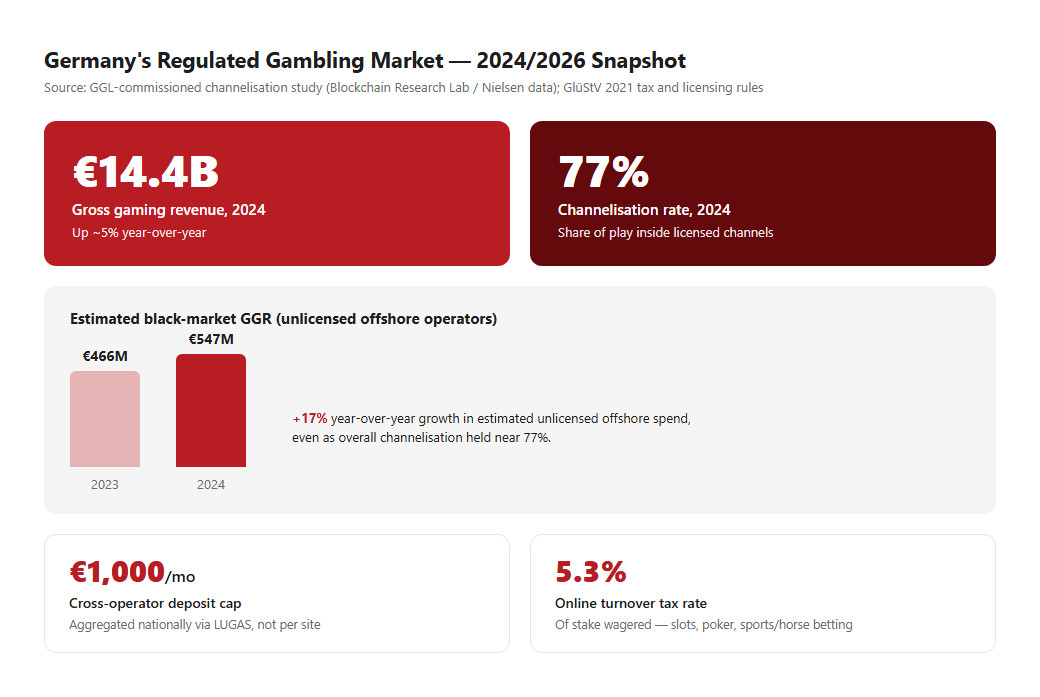
Germany's regulated gambling market generated approximately €14.4 billion in gross gaming revenue in 2024 (the most recent full-year figure available at time of writing), a roughly 5% increase year-over-year, making it one of the largest single-country gambling markets in Europe by GGR - a scale point covered in more comparative detail in our 15 Biggest Gambling Markets in the World for 2026, where Germany ranks among the top global markets.
The GGL-commissioned channelisation study (Blockchain Research Lab, using Nielsen activity data) put the 2024 channelisation rate at roughly 77% - meaning about three-quarters of real-money online gambling activity by German residents flows through GGL-licensed, compliant channels. The remainder, an estimated €547 million in black-market GGR in 2024 (up roughly 17% from an estimated €466 million in 2023), still goes to unlicensed offshore operators, and the regulator's own report frames this as a rising trend rather than a shrinking one. Industry trade bodies have publicly disputed the GGL's black-market estimate as too conservative, arguing the true unlicensed share is meaningfully higher - so treat the 77% figure as the regulator's own methodology-dependent estimate, not an uncontested consensus number.
For advertisers and affiliates, the market-size and channelisation data together tell a clear story: Germany is a large, still-growing regulated market, but the compliance bar (licensing, deposit limits, product restrictions) is exactly what keeps roughly a quarter of demand outside it. Any GEO-targeting strategy into Germany needs to be built around licensed-operator offers to be sustainable - TrafficSigma's GEO-targeting for German traffic is designed to route campaigns to advertisers who hold their own compliant German licensing, not to route around it.
Launch your next campaign on TrafficSigma traffic
The bottom line for advertisers and operators
Choosing how to approach the German market comes down to the same handful of factors this guide has walked through: which license category your product actually falls under, whether your target state permits it (critical for online table games specifically), and whether your compliance stack can handle turnover-based taxation and cross-operator deposit tracking rather than the GGR-based, single-operator models common elsewhere in Europe. Get those three right and Germany is one of the largest, most stable regulated iGaming markets in Europe; get them wrong and you're building on a license category, state, or tax assumption that doesn't hold up.
For performance marketers and affiliates, the opportunity sits squarely with licensed operators competing for a share of that 77%-and-growing regulated channel - not with routing around German rules. TrafficSigma's self-serve platform lets you target German traffic with the GEO, device, and carrier precision the market's compliance-heavy landscape demands, across push, native, and pop formats, so your campaigns reach compliant German audiences without guesswork.