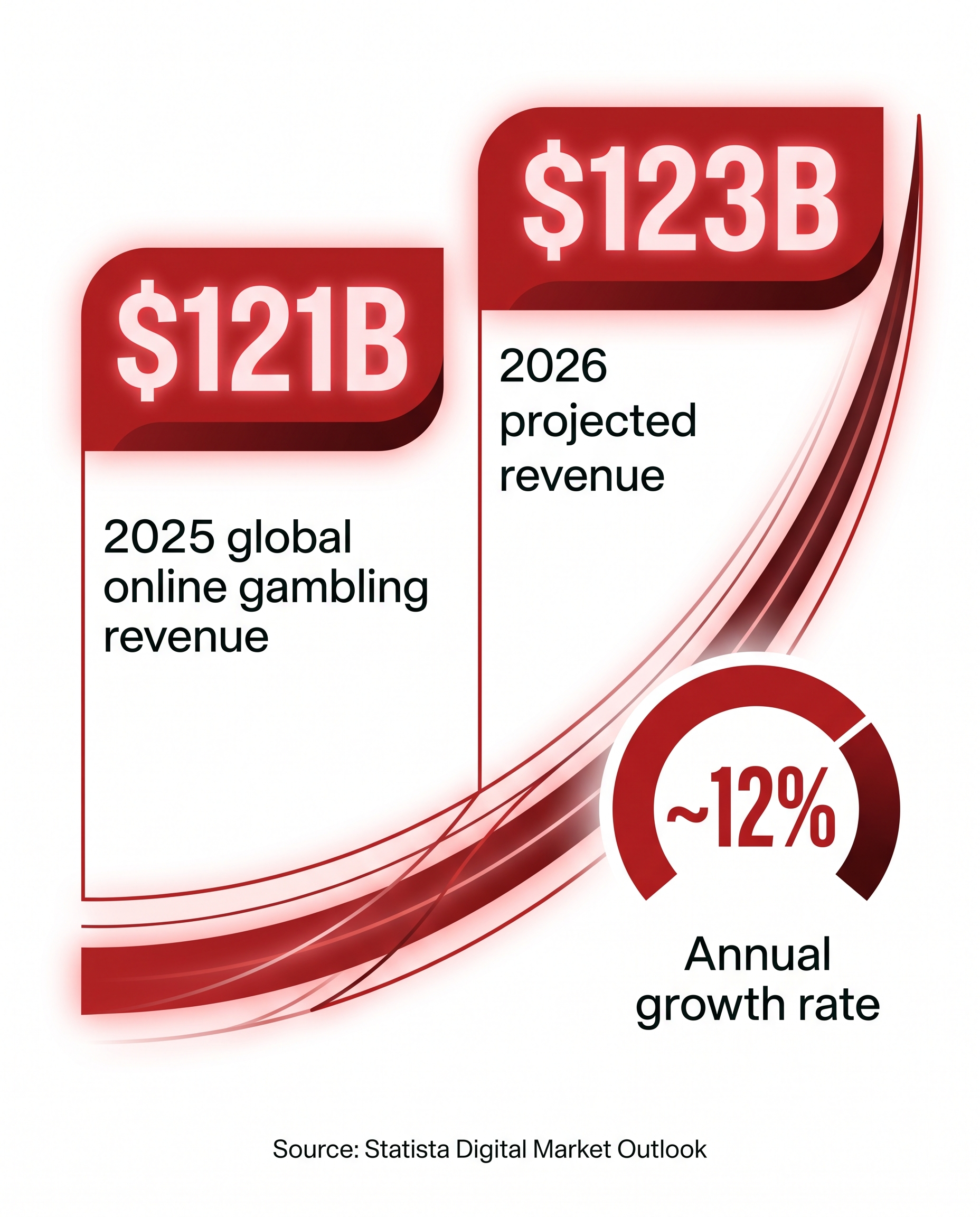
The global online gambling market generated an estimated $121 billion in revenue in 2025, on pace for roughly $123 billion in 2026, growing at roughly 1.7% year-over-year on those figures, according to Statista's Digital Market Outlook.
That growth is not evenly distributed - it is entirely gated by law. The same casino game is a licensed, taxed product in Stockholm, a tolerated gray-market bet in Mexico City, and a criminal offense in Doha, depending on nothing but which side of a border the player sits on.The TrafficSigma team analyzed regulatory frameworks, licensing bodies, and enforcement patterns across more than 30 markets to map exactly where online gambling is legal, where it's gray, and where it's banned outright as of 2026. This guide is not legal advice - gambling law changes fast and varies by state, province, and even city, so always confirm current local regulation with a licensed attorney or the relevant regulator before launching or advertising a real-money product in any market. What follows is a compliance-literacy map for operators, affiliates, and media buyers who need to understand a market's legal shape before they target it.
The four regulatory models that shape every market
There is no single global answer to "is online gambling legal?" - the honest answer is always "it depends which country, and often which region within that country." Every market on earth falls into one of four structural models, and knowing which one applies to your target GEO tells you more than any single country fact ever could.
- Fully regulated and licensed markets: A dedicated regulator issues online gambling licenses, sets tax rates, mandates player-protection tools, and enforces advertising rules. Operators without a local license are actively blocked or fined. The UK (UKGC), Malta (MGA), Sweden (Spelinspektionen), Italy (ADM), and Ontario, Canada (AGCO/iGaming Ontario) are textbook examples. This is the safest model for advertisers because the rules - including ad content and audience-targeting restrictions - are written down and enforced.
- Gray or tolerated markets: No dedicated online-gambling law exists, so offshore-licensed operators (commonly Curaçao-licensed) serve local players without being explicitly authorized or explicitly blocked. Much of Latin America outside Colombia, Peru, and Brazil, and large parts of Africa and Asia, still function this way. Gray markets are often the highest-volume, highest-margin GEOs for affiliates precisely because enforcement is inconsistent - but that inconsistency can flip to a sudden crackdown with no warning, as Chile demonstrated in 2025.
- Fully prohibited markets: Online gambling is a criminal or civil offense for the operator, the player, or both, with no licensing path at all. Mainland China and most Gulf states fall here on religious or state-policy grounds; India moved a major real-money-gaming segment into this category in 2026 (more below).
- Federal countries with state/province-level variance: The country has no single national answer - the United States and Canada are the two clearest examples, where legality, tax rate, and even which specific games are allowed change at the state or provincial line. Argentina runs the same model at the provincial level in Latin America.
Once you know which of these four buckets a target market sits in, the region-by-region breakdown below tells you exactly what that means in practice.
Create Ads with TrafficSigma today!
North America: state-by-state legality inside one federal ban
The US is the world's clearest example of the federal-variance model. At the national level, the Wire Act (1961, narrowed to sports betting by a 2011 DOJ opinion) and the Unlawful Internet Gambling Enforcement Act (UIGEA, 2006) govern payment processing, but neither one legalizes or bans online casino play outright - that decision sits entirely with each state. The 2018 repeal of PASPA (the federal sports-betting ban) is what triggered the current state-by-state wave.
As of 2026, full online casino (iGaming) - slots, table games, live dealer - is regulated in seven states: New Jersey, Pennsylvania, Michigan, West Virginia, Connecticut, Delaware, and Rhode Island, with Maine expected to become an eighth market via tribal-operator launches, though a firm 2026 launch date has not been confirmed. Roughly 30+ additional states plus Washington, D.C. permit online sports betting without full casino-style iGaming. In New Jersey, online casino revenue overtook physical casino revenue in 2025 - the clearest signal yet that regulated iGaming is now a mainstream, not niche, product. West Virginia's regulated iGaming market alone generated $56.1 million in state tax revenue in 2025.
Canada tells a similar provincial-variance story. Ontario is the standout: since opening a competitive, privately-operated market in April 2022 under the AGCO and iGaming Ontario, the province recorded roughly $98.3 billion in total wagers in 2025, $4 billion in gaming revenue (up 34% year-over-year), and about $807 million in provincial tax revenue. Most notably, 83.7% of Ontario players now wager through regulated, licensed sites rather than unregulated offshore ones, according to a 2025 Ipsos/iGaming Ontario channelization study - a strong argument for regulation as a player-protection tool, not just a tax grab. Every other Canadian province runs a single-operator, government-monopoly model instead - British Columbia's PlayNow and Quebec's Loto-Québec/Mise-o-jeu being the two largest - with no open licensing for private operators.
Mexico sits in the gray-market bucket: an old, non-internet-specific federal gaming and permit law technically covers wagering, and permit holders offer online sports betting and casino products, but there is no dedicated modern online-licensing framework, leaving enforcement inconsistent.
| Country/Region | Regulatory model | Regulator(s) | Online casino status | Online sports betting status |
|---|---|---|---|---|
| United States (federal) | State-by-state variance | 50 individual state regulators | Legal in 7-8 states (NJ, PA, MI, WV, CT, DE, RI, ME) | Legal in 30+ states + D.C. |
| Canada - Ontario | Fully regulated (provincial) | AGCO / iGaming Ontario | Legal, open licensing | Legal, open licensing |
| Canada - other provinces | Provincial monopoly | Provincial crown corporations (BCLC, Loto-Québec, etc.) | Government-operator only | Government-operator only |
| Mexico | Gray/tolerated | Federal permit system (pre-internet law) | Tolerated via permit holders | Tolerated via permit holders |
Europe: the most mature regulated markets in the world - but tightening
Europe is home to the deepest bench of fully regulated online gambling markets anywhere: the UK (UK Gambling Commission), Malta (Malta Gaming Authority, the licensing hub for a large share of global operators), Sweden (Spelinspektionen), Denmark (Spillemyndigheden), Italy (ADM), Spain (DGOJ), Germany (GGL, operating under the 2021 Interstate Treaty on Gambling and fully enforcing since 2023), the Netherlands (KSA, market opened October 2021), France (ANJ), and Portugal (SRIJ). In each, operators need a local license, pay local gambling tax, and follow local advertising and player-protection rules - this is the model every other region is gradually moving toward.
The important nuance for 2026: regulation in Europe is getting stricter, not just more widespread. The Netherlands has escalated its advertising restrictions sharply - an untargeted-advertising ban since July 2023, a ban on athlete, team, and competition sponsorship deals effective July 2025, and a near-total online gambling advertising ban reported to be advancing as of mid-2026. Germany's GGL has intensified enforcement against unlicensed operators since early 2024, with a formal review of the Interstate Treaty's effectiveness expected in 2026. The takeaway for advertisers: a "regulated" label in Europe increasingly means a shrinking, tightly-defined advertising channel, not an open one - creative, targeting, and audience-age rules deserve a compliance check per country, every time, not a one-off review.
| Country | Regulator | Market status | 2026 trend |
|---|---|---|---|
| United Kingdom | UK Gambling Commission (UKGC) | Fully regulated, mature | Ongoing affordability-check reforms |
| Malta | Malta Gaming Authority (MGA) | Fully regulated, licensing hub | Stable, high operator concentration |
| Sweden | Spelinspektionen | Fully regulated | Stable |
| Denmark | Spillemyndigheden | Fully regulated | Stable |
| Italy | ADM (Agenzia delle Dogane e dei Monopoli) | Fully regulated | Stable |
| Spain | DGOJ | Fully regulated | Stable |
| Germany | GGL | Fully regulated since 2023 | Enforcement intensifying; 2026 treaty review |
| Netherlands | KSA (Kansspelautoriteit) | Fully regulated, opened 2021 | Advertising rules tightening sharply |
| France | ANJ | Fully regulated | Stable |
| Portugal | SRIJ | Fully regulated | Stable |
Latin America: the region moving fastest from gray to regulated
Latin America is the clearest live example of a region migrating from gray-market to regulated status in real time. Colombia got there first - its 2016 eGaming Act, enforced by regulator Coljuegos, makes it the region's longest-standing fully licensed online gambling market. Peru followed via Supreme Decree 005-2023-MINCETUR, which took effect in February 2024, becoming the third Latin American country to formally regulate after Colombia and Argentina's provincial framework.
Brazil is the region's biggest prize and its newest regulated market: the "Bets" law (Law 14,790/2023) took effect January 1, 2025, with the Secretariat of Prizes and Betting (SPA), under the Ministry of Finance, as regulator. The market launched with 78 operators and 138 brands, and pre-launch estimates put the addressable market near BRL 35 billion in gross gaming revenue. But regulation has meant real enforcement, not a rubber stamp: dozens of operators have had their licenses suspended or revoked since launch, per SPA enforcement actions, shrinking the active licensed-operator count from its initial post-launch level - a useful reminder that "newly regulated" does not mean "anything goes." Brazil taxes gross gaming revenue at 12% and bans betting on credit and sign-up bonuses outright, with mandatory CPF-linked, facial-recognition KYC.
Argentina regulates at the provincial level rather than nationally - more than 15 of its 23 provinces plus Buenos Aires City had implemented their own online gambling frameworks as of 2025, making it Latin America's version of the US state-by-state model. Chile is the region's clearest gray-market-in-transition: its Senate approved a regulatory bill in a general vote in August 2025, but as of late 2025 the Supreme Court ruled that online gambling remains illegal absent express authorization, triggering site-blocking enforcement even as the legislative path to regulation continues.
| Country | Regulator | Status | Key detail |
|---|---|---|---|
| Colombia | Coljuegos | Fully regulated since 2016 | Region's most established framework |
| Brazil | SPA (Secretariat of Prizes and Betting) | Fully regulated since Jan 2025 | 12% GGR tax; active enforcement already shrinking operator count |
| Peru | MINCETUR (Supreme Decree 005-2023) | Fully regulated since Feb 2024 | Third LatAm country to formally regulate |
| Argentina | Provincial regulators | Federal/provincial variance | 15+ of 23 provinces regulated as of 2025 |
| Chile | Pending Senate bill / courts | Gray, actively resolving | Supreme Court: illegal without express authorization (2025) |
| Mexico | Federal permit system | Gray/tolerated | Covered above under North America |
Asia-Pacific: the widest range, from open markets to fresh bans
Asia-Pacific spans the entire spectrum in one region. Australia sits in a hybrid category of its own: the Interactive Gambling Act 2001 bans online casino games and poker outright for any operator serving Australian customers, while pre-game online sports and racing wagering remains legal through licensed Australian bookmakers (in-play sports betting online is banned). The 2025-26 federal budget added AU$112.7 million over five years to fund harm-reduction infrastructure, including the BetStop national self-exclusion register - a sign that even in a market with legal online betting, the policy direction is toward tighter player protection, not looser rules.
India is 2026's biggest regulatory story in the region, and it is moving toward prohibition, not liberalization. Several states had already passed their own bans on real-money online gaming, including Tamil Nadu and Karnataka, whose state bans the Supreme Court upheld in May 2026 (Andhra Pradesh and Telangana separately restrict real-money gaming under their own 2020 state legislation) - alongside the GST Council's 28% goods-and-services tax on the full face value of bets (in effect since October 2023). The bigger shift: a national Promotion and Regulation of Online Gaming Act, 2025 received presidential assent in August 2025, and its implementing rules were notified in April 2026, prohibiting real-money online gaming nationwide along with its advertising and payment processing - collapsing what had been a fragmented, state-by-state gray zone into a single national restriction. The exact current enforcement status should be confirmed directly, since a precise nationwide commencement date has not been consistently reported.
Elsewhere in the region, treat specifics cautiously rather than citing exact figures: Japan keeps online gambling prohibited outside narrow carve-outs for public sports betting and pachinko; China prohibits it on the mainland, with Macau operating as a separate special administrative region with its own licensed land-based casino industry; the Philippines has a history of offshore online-gaming licensing through PAGCOR alongside periodic enforcement crackdowns; and Singapore restricts online gambling tightly, with state-linked Singapore Pools functioning as the primary legal channel. These four markets are worth monitoring rather than targeting without a fresh legal check, since public detail on current enforcement changes quickly.
| Country | Regulatory model | Online casino | Online sports betting | 2026 note |
|---|---|---|---|---|
| Australia | Regulated hybrid | Banned (IGA 2001) | Legal, pre-game only | AU$112.7M harm-reduction funding added |
| India | National prohibition | Banned in Karnataka and Tamil Nadu by state law (Supreme Court-upheld); banned nationwide under the 2025 Act | Banned nationwide under the 2025 Act | Real-money gaming now prohibited nationwide - confirm current enforcement status |
| Japan | Prohibited (narrow carve-outs) | Banned | Limited public-sports carve-outs only | Generalize; verify locally before targeting |
| China (mainland) | Prohibited | Banned | Banned | Macau is a separate, distinct jurisdiction |
| Philippines | Gray/historically permissive offshore | Offshore-licensed history via PAGCOR | Offshore-licensed history via PAGCOR | Periodic enforcement crackdowns |
| Singapore | Tightly restricted | Effectively banned | State-linked exclusivity (Singapore Pools) | Very low tolerance for unlicensed operators |
Africa and the Middle East: fast-growing gray markets next to a religious-law ban
Sub-Saharan Africa's three largest gambling markets - South Africa, Nigeria, and Kenya - are all growing quickly under regional, not national, regulatory models. South Africa's gross gambling win is estimated at roughly $5.2 billion in 2025, and Nigeria's at roughly $1.6 billion - both figures come from unnamed industry trade estimates rather than a named regulator or research firm, and should be treated as directional rather than precise. South Africa licenses gambling at the provincial level (for example, the Western Cape Gambling and Racing Board), which means online sports betting is legal and licensed province-by-province while online casino-style games remain largely restricted at the national level - a proposed 20% gross gambling tax on online betting has also been floated. Nigeria layers a new federal tax on top of an already fragmented system: a 5% withholding tax on residents' winnings and 15% on non-residents took effect in January 2025, while the federal National Lottery Regulatory Commission and the state-level Lagos State Lotteries Board continue to contest regulatory turf - a live example of the federal-vs-subnational friction that shows up in almost every large gambling market eventually. Kenya replaced its 1966 betting law entirely with the Gambling Control Act 2025, with the Betting Control and Licensing Board (BCLB) remaining the enforcement regulator.
The Middle East is overwhelmingly prohibited: most Gulf states ban gambling outright on Islamic-law grounds, with no online licensing path at all. The one exception worth knowing - even though it's land-based, not online - is the United Arab Emirates, which formalized the General Commercial Gaming Regulatory Authority (GCGRA) - sources differ on the exact date - and issued Wynn Resorts the UAE's first commercial casino gaming license in October 2024, for the Wynn Al Marjan Island integrated resort in Ras Al Khaimah, expected to open in early 2027. It's a genuinely notable regional first, but it does not signal any opening for online gambling in the Gulf - treat the UAE's land-based casino license as a separate development from its online-gambling stance, which remains prohibited.
| Country/Region | Regulatory model | Regulator | Status |
|---|---|---|---|
| South Africa | Provincial licensing | Provincial gambling boards (e.g. Western Cape) | Online betting legal/licensed; online casino largely restricted nationally |
| Nigeria | Federal/state overlap | National Lottery Regulatory Commission + state boards (e.g. Lagos) | Regulated with new 2025 winnings tax |
| Kenya | National regulation | Betting Control and Licensing Board (BCLB) | Regulated under Gambling Control Act 2025 |
| Most Gulf states | Fully prohibited | N/A | No online licensing path; religious-law basis |
| UAE | Emerging, land-based only | GCGRA | First casino license issued 2024 (land-based); online gambling remains prohibited |
How these rules should shape your GEO targeting
Choosing where to run gambling-adjacent campaigns comes down to the same three factors every time: which of the four regulatory models a GEO falls under, how enforced and how current that status actually is (gray markets can flip to bans with little warning, as Chile and India both show), and what the local advertising rules specifically allow - a "legal" market like the Netherlands can still be a near-closed advertising channel. Getting those three factors right before you launch, not after, is what separates a durable iGaming campaign from one that gets shut down mid-flight.
That's exactly the layer TrafficSigma is built to support: 248+ GEOs with granular country, region, device, and carrier-level targeting mean you can respect a market's specific rules - running in provinces or states where a product is licensed, excluding the ones where it isn't - rather than blasting a single creative at an entire country and hoping enforcement never catches up. TrafficSigma doesn't provide legal or compliance advice and traffic targeting is not a substitute for a local licensing or legal review, but precise GEO-, device-, and carrier-level control is what lets you build campaigns around each market's actual rules instead of against them.
Get GEO-precise with TrafficSigma before your next launch.