
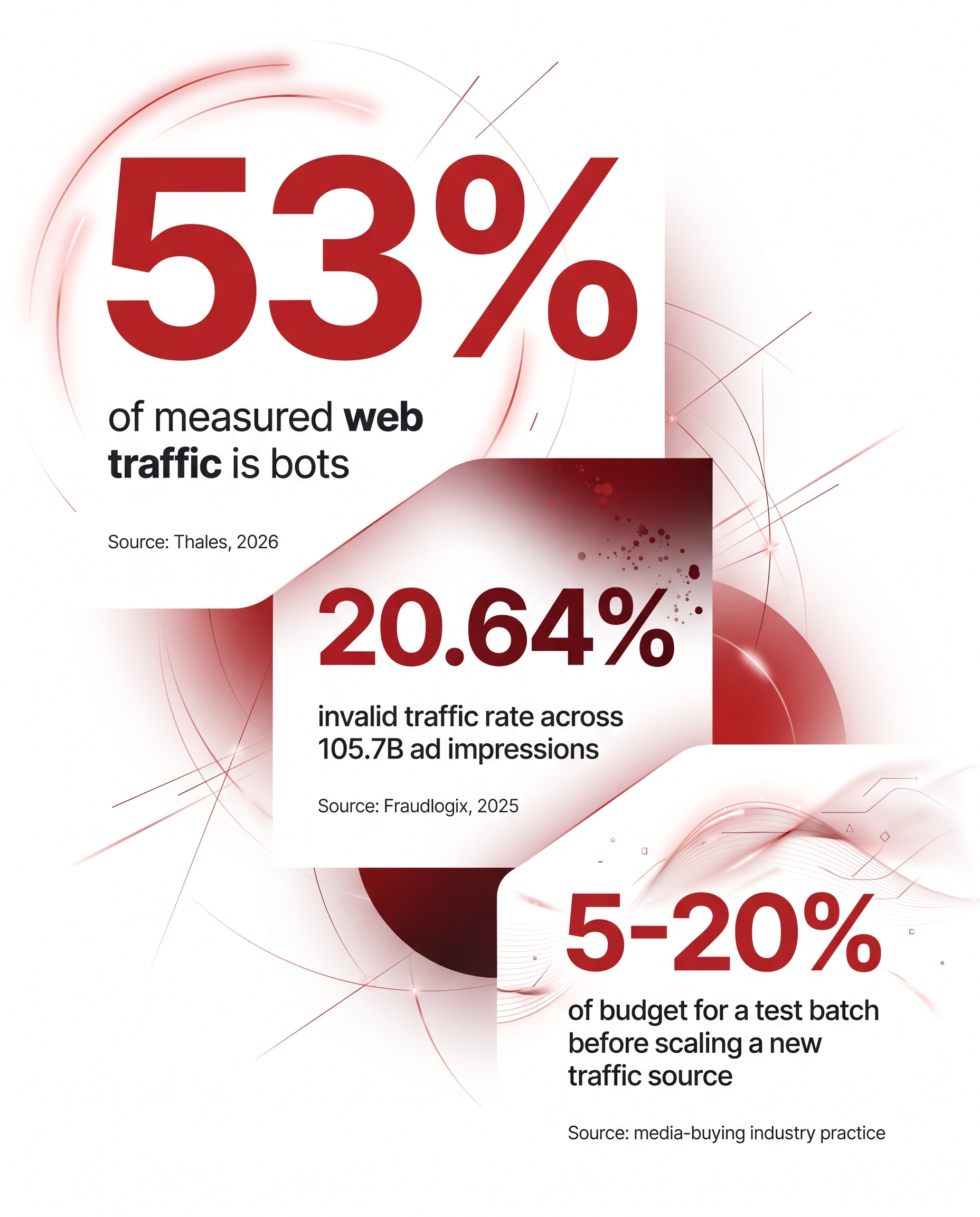
Bots now account for roughly 53% of all measured web traffic, according to Thales' 2026 bot-traffic research, and invalid traffic across digital advertising reached a global rate of 20.64% in 2025 based on Fraudlogix's analysis of 105.7 billion impressions.
That is the market you are buying into every time you buy website traffic - a market where roughly one in five clicks you pay for may not come from a real person at all.The TrafficSigma team analyzed how buyers get burned when they buy traffic, cross-referenced Media Rating Council (MRC) and IAB invalid-traffic standards, and built this guide so you can buy real website traffic - targeted, direct-click, and bulk - without paying for a botnet. Below is a bot-traffic audit checklist, a test-budget methodology, and the exact quality-verification criteria to run before you commit real budget to any seller.
The framework: three traffic-quality models you need to understand first
There is no single "real vs. fake" switch - invalid traffic exists on a spectrum, and the MRC's own IVT Detection and Filtration Guidelines split it into two formal categories. Understanding which category a problem falls into determines whether you can catch it with a quick analytics check or need deeper forensic verification.
- GIVT (General Invalid Traffic): Traffic caught by routine, list-based filtration - known bots, spiders, crawlers, non-browser user-agent strings, and pre-fetch/pre-render requests. This is the "cheap" bot traffic: data-center IPs, known bot signatures, and traffic that any basic analytics filter or ad-verification tag should catch immediately.
- SIVT (Sophisticated Invalid Traffic): Traffic disguised as human - hijacked devices, malware-driven clicks, adware injections, and click-farm labor using real devices and residential IPs. SIVT requires advanced analytics and multipoint corroboration to detect, because it is specifically engineered to pass GIVT-level filters.
- Real, verified traffic: Genuine users with organic session behavior - variable dwell time, natural navigation patterns, real engagement with on-page elements, and traffic that clusters the way an actual audience clusters (not uniformly across GEOs, devices, or delivery hours).
When you buy website traffic - whether you buy cheap website traffic in bulk or buy targeted website traffic for a specific GEO - your job before spending real budget is to confirm which of these three buckets a seller's traffic actually falls into. A seller who can't explain their own GIVT/SIVT filtration process is telling you they haven't checked either.
Translate this into action: before you send a single dollar to a new seller, ask them directly which invalid-traffic standard they filter against. A seller who doesn't recognize the terms GIVT or SIVT is very likely reselling unfiltered inventory.
The bot-traffic audit checklist
Run this checklist against any traffic you're evaluating - whether it's a sample batch from a new seller or scaled traffic you already bought and want to verify retroactively. This is the core of any website traffic quality checklist worth using.
- Session duration: Real visitors, even ones who bounce immediately, typically trigger at least one scroll event or stay on-page for 2-3 seconds. Bot traffic frequently shows sub-one-second sessions across the board - if your median session duration is under 2 seconds, that's a strong bot-traffic audit red flag, not a UX problem.
- Bounce rate relative to industry baseline: A high bounce rate alone isn't proof of fraud - healthy bounce rates already range from roughly 20-45% for ecommerce up to 65-85% for media/publishing sites, per industry benchmark data. What matters is bounce rate paired with near-zero session duration; that combination, not bounce rate alone, is the tell.
- Pageview spikes per session: If your typical visitor views 1-3 pages per session and a batch of new traffic suddenly averages 15-20+ pageviews per session in seconds, you're looking at a scripted crawl pattern, not a human reading your site.
- Geographic and delivery-time clustering: Real audiences arrive unevenly - clustered around time zones, weighted toward a handful of cities, moving with daily and weekly rhythm. Traffic that arrives in near-perfectly even intervals (say, almost exactly 1,000 visits every hour for ten hours straight) or clusters entirely inside one city or ASN block is a classic click-farm or proxy-pool signature.
- Device and browser fingerprint diversity: A real GEO-targeted audience shows a realistic device/OS/browser mix for that market. Traffic showing a single browser version or device fingerprint across thousands of "unique" visits did not come from thousands of unique people.
- Zero-engagement rate: Bots essentially never interact with live chat widgets, timed pop-ups, or scroll-triggered overlays. If a traffic batch shows heavy volume but a near-total absence of any on-page interaction, that's a direct signal - this is one of the simplest bot traffic audit checks you can run inside your own analytics without any third-party tool.
Do this after every new campaign launch, not just once: pull these six metrics for the first 24-48 hours of any new traffic source before you scale spend, using whatever web analytics platform you already run (GA4, a first-party dashboard, or your ad network's own reporting).
Launch your next campaign with TrafficSigma's self-serve traffic!How to buy traffic without bots: a test-budget methodology
The single biggest mistake buyers make is committing a full budget to a new source on day one. Media-buying practice generally allocates 5-25% of total budget to testing before scaling, with smaller accounts starting around 10-15% and larger accounts running toward the higher end of that range - sometimes 20-25% - to keep enough volume for a statistically meaningful read. Apply that same discipline specifically to traffic-quality testing, not just creative or audience testing:
- Stage 1 - Micro test (5-10% of planned budget): Buy the smallest viable batch a seller allows. Run the full bot-traffic audit checklist above against this batch before you commit another dollar. This is the stage where cheap website traffic sellers running GIVT-level bot traffic get caught fastest - their failure shows up immediately in session and engagement data.
- Stage 2 - Confirmation test (another 10-15%): If Stage 1 passes, repeat the same checklist at a slightly larger volume, across a broader time window, and ideally a second GEO or device segment if you're buying targeted website traffic across multiple markets. This stage catches SIVT-style traffic that can pass a tiny first batch but reveals patterns (clustering, timing, fingerprint repetition) only at moderate scale.
- Stage 3 - Scale with guardrails: Only move to full budget once both stages clear, and even then, set an ongoing weekly re-check on the same six metrics - sellers can and do change traffic mix after a buyer stops watching closely.
Translate this into action: never let a low headline CPM or CPC talk you out of Stage 1. A price that looks too cheap for buy bulk website traffic is the exact scenario this staged approach is built to catch before it costs you a full budget.
Start scaling your campaigns with TrafficSigma
Quality-verification criteria: real traffic vs. bot traffic signals
Beyond the audit checklist, use these deeper verification criteria to formally sign off on a seller before treating them as a long-term source - this is the difference between a quick sanity check and genuine due diligence on where to buy website traffic.
| Verification criterion | Real traffic signal | Bot / SIVT warning signal |
|---|---|---|
| Session duration | Variable, average 2+ seconds even on bounces | Uniform, frequently sub-1-second |
| Engagement rate | Nonzero interaction with chat/pop-ups/scroll triggers | Near-zero interaction despite volume |
| Delivery pattern | Uneven, follows time-zone/daypart rhythm | Metronomic, near-identical hourly volume |
| Geographic spread | Distributed across a GEO's real population centers | Tight clustering in one city/ASN |
| Device/browser mix | Realistic diversity matching the target market | Single fingerprint repeated at scale |
| Source transparency | Seller discloses supply sources, GIVT/SIVT filtration method | Vague "premium network," no sourcing detail |
| Conversion follow-through | Clicks convert to leads/sales at a plausible rate for the vertical | High clicks, near-zero downstream conversions |
Every seller-side red flag in the right-hand column compounds the others - one alone might have an innocent explanation, but two or more together is where you stop testing and walk away. A lack of source transparency paired with an unusually low headline price is consistently the strongest combined predictor of click-farm or bot-heavy inventory.
Red flags: when a traffic offer is too cheap to be real
If you're actively shopping to buy traffic, watch for these seller-side patterns before you place an order:
- Pricing that undercuts the market by an order of magnitude. Verified ad-network CPMs for real display, push, or pop traffic generally start well under a dollar at the low end (exact floors vary by network and GEO - treat any specific figure as directional, not a fixed benchmark); offers promising millions of visits for a few dollars are, almost without exception, GIVT or click-farm SIVT traffic, not real direct click traffic.
- No GEO, device, or source breakdown offered up front. A legitimate seller can tell you, before you buy, which countries, device types, and traffic sources (push, pop, native, in-page) your spend will draw from. If they can't or won't, that opacity is the product.
- Guaranteed SEO or ranking benefits. Any seller who pitches purchased traffic as a way to directly improve organic search rankings is selling a myth - search engines do not use raw visit volume as a ranking signal, and this pitch is a long-standing marker of low-quality click-farm resellers.
- No sample or small-batch option. A seller unwilling to sell you a Stage 1 micro-test batch (see the test-budget methodology above) is a seller who doesn't want you auditing what you're buying before you're financially committed.
- Refusal to name a filtration standard. Ask directly whether they filter against GIVT/SIVT definitions or run any MRC-aligned verification. "We use premium sources" with no further detail is not an answer.
Translate every one of these into a pre-purchase question you literally ask the seller in writing - a legitimate provider answers all five without hesitation; a click-farm reseller will dodge at least two.
Once you've filtered sellers against this list and passed your own traffic through the staged test-budget process above, the natural next question is simply where to buy website traffic from a source that already builds this kind of transparency in by default.
Where TrafficSigma fits into a bot-free buying strategy
Everything above is seller-agnostic - it's the due-diligence process you should run regardless of who you buy from. But it's worth being direct about how TrafficSigma is built around exactly these failure points. TrafficSigma runs 3-level fraud protection across every format on the network - push, in-page push, pop/popunder, domain redirect, native, calendar push, and Telegram Mini App ads - with vetted premium sources rather than open, unaudited exchanges. For buyers specifically worried about the click-farm and SIVT patterns described above, direct-click and domain-redirect traffic on the network is sourced from real domain-level intent rather than incentivized or scripted clicks, and granular GEO, device, OS, and carrier targeting lets you run the Stage 1/Stage 2 micro-test methodology from this guide natively, down to the sub-source level, before committing to Target CPA or Performance Mode auto-scaling across 248+ GEOs.
Launch your next campaign on TrafficSigma traffic
What separates real traffic from a bot-heavy source
Buying real website traffic comes down to three decision factors: knowing the difference between GIVT, SIVT, and genuinely verified human traffic; running a disciplined staged test-budget before you scale any new source; and treating seller transparency about sourcing and filtration as a hard gate, not a nice-to-have. Skip any one of these and the market's own numbers - bots making up roughly half of measured web traffic, IVT rates around one-in-five impressions industry-wide - stop being an abstract statistic and start being your actual campaign performance.
Once you've internalized this framework, the practical next step is choosing a source built to survive it. TrafficSigma's 3-level fraud protection, granular targeting down to the sub-source level, and transparent GEO/device reach across 220+ markets are designed specifically so that when you run the audit checklist in this guide against TrafficSigma traffic, it passes.