
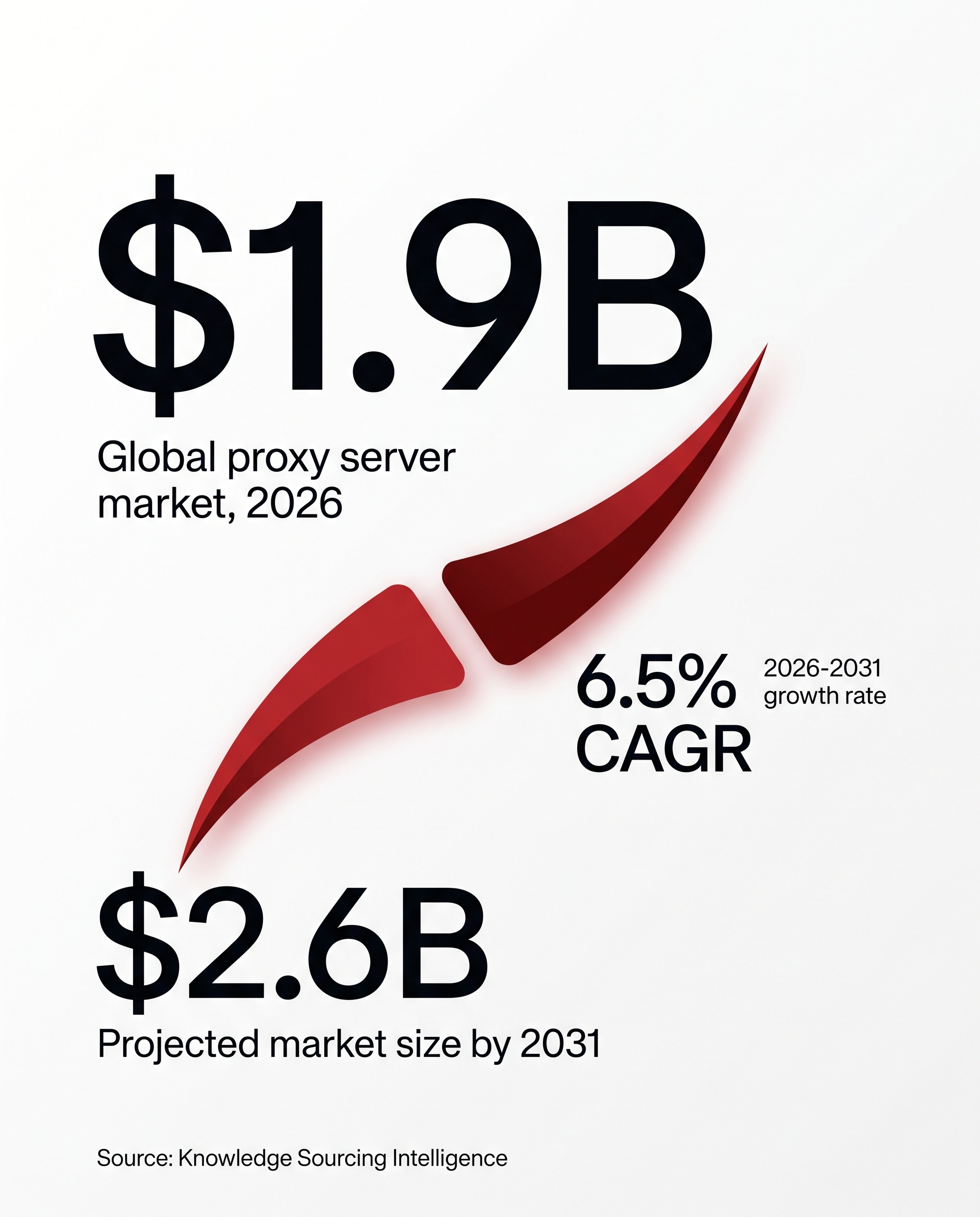
The global proxy server market is valued at roughly $1.9 billion in 2026, on pace to reach $2.6 billion by 2031 at a 6.5% CAGR, according to Knowledge Sourcing Intelligence - growth driven largely by ad verification and geo-testing demand.
For affiliate marketers, that tracks directly with how many campaigns now need a local-market check before spend goes live.The TrafficSigma team put together this guide to answer the question plainly, then get into what actually matters for performance marketers: which proxy type to use, when, and why a proxy isn't the same tool as a VPN or an antidetect browser.
What is a proxy?
To define proxy simply: a proxy (short for proxy server) is an intermediary server between your device and the internet. Your traffic goes through it first, and it forwards the request using its own IP address and location - the site you're visiting sees the proxy's IP, not yours. That's the proxy server meaning in one line, and the working proxy definition for this guide: a stand-in connection that lets you appear to browse from somewhere else.
Why affiliate marketers actually use proxies
A proxy for affiliate marketing isn't a privacy tool - it's a QA tool. Three use cases dominate:
- Geo-testing ad creatives. Before a campaign goes live in Germany, Brazil, or the Philippines, confirm the landing page, currency, language, and offer render correctly from an IP in that market - not from your office IP, which often gets a default or English-language fallback.
- Ad and compliance verification. Networks and advertisers use local-market IPs to confirm a redirect chain shows the approved creative, the correct disclaimer, and the contracted destination URL in each GEO - and that no unauthorized domain hijacks the chain mid-redirect.
- Avoiding account and IP flagging. Platforms flag accounts that log in from the same IP across too many unrelated profiles. A dedicated proxy per account keeps routine, legitimate account management from tripping fraud signals meant for abuse.
Used this way, a proxy confirms what a real user in a real market actually sees, before you spend a media budget finding out the hard way.
Launch your next campaign with TrafficSigma's self-serve traffic!Types of proxy
There's no single "best" proxy - the right type depends on what you're checking and how often. Four types cover almost every affiliate-marketing use case:
- Datacenter proxy: IPs hosted on cloud/server infrastructure, not a real residential or mobile connection. Cheapest and fastest, but easy for platforms to flag as non-residential - best for high-volume, low-sensitivity checks rather than final compliance sign-off.
- Residential proxy: Routes traffic through a real home IP assigned by an ISP to an actual household. Looks like ordinary consumer traffic, making it the standard choice for geo-testing ad creatives and offer pages.
- ISP proxy: A hybrid - registered to a residential ISP (so it looks residential) but hosted on stable server infrastructure instead of a rotating household connection. Gives you a static, fast, residential-looking IP for sessions that need to stay put longer than typical residential IPs allow.
- Mobile proxy: Uses IPs assigned by mobile carriers to real 3G/4G/5G devices. Carrier-grade NAT shares IPs across huge subscriber pools, making them the hardest for a platform to block without blocking real users - at the highest cost and slowest provisioning.
For a straightforward residential proxy vs datacenter proxy call: pick datacenter for cheap, high-volume, low-scrutiny checks, and residential (or ISP, for a static session) whenever the test needs to survive the same fraud and bot-detection layer a real visitor would face.
See TrafficSigma pricing and ad formats
Proxy vs VPN vs antidetect browser
These three terms get used interchangeably, and that's where most confusion (and most account bans) comes from. Each solves a different problem:
- Proxy: changes your apparent IP and location only. No encryption, no change to your browser fingerprint (screen size, fonts, timezone, WebGL, and the dozens of other signals a site reads).
- VPN: also changes your IP, plus encrypts the whole connection for privacy. Like a proxy, it leaves your fingerprint untouched - a platform still sees the same device behind a new IP.
- Antidetect browser: doesn't touch your IP by itself - it isolates and customizes the fingerprint so each profile looks like a distinct device. Typically paired with a dedicated proxy per profile, since platforms cross-check IP and fingerprint together.
For proxy vs VPN: a VPN fits general encryption and privacy; a proxy is the lighter, faster tool when only the apparent location needs to change. Neither replaces an antidetect proxy setup - pairing a dedicated proxy with an antidetect browser profile - which is what real account-level separation requires.
A brief note on responsible use
Proxies are legitimate infrastructure used daily for QA, ad verification, and account security - by affiliates, brand-safety teams, and ad platforms themselves. Used responsibly, they confirm what real users see; they should never fabricate traffic, fake clicks, or misrepresent a visitor's actual location to an advertiser. Test against your own campaigns and disclosed terms, and check the acceptable-use policy of any network or proxy provider before running verification at scale.
Get iGaming traffic from TrafficSigma now!
Comparison table: proxy types at a glance
| Proxy type | Source of IP | Speed | Cost | Best for |
|---|---|---|---|---|
| Datacenter | Cloud/hosting infrastructure | Fastest | Lowest | Bulk, low-sensitivity checks |
| Residential | Real home ISP connection | Moderate | Mid-high | Geo-testing ad creatives, offer QA |
| ISP | ISP-registered, server-hosted | Fast | Mid-high | Long, static verification sessions |
| Mobile | Mobile carrier network | Slowest to provision | Highest | High-scrutiny account/compliance work |
Pick a proxy type for the job, not the price
The right proxy choice comes down to three factors: how closely the destination site scrutinizes traffic, how long a session needs to stay on one IP, and your budget for that level of realism. Datacenter handles cheap, high-volume checks; residential and ISP handle real-market geo-testing and compliance; mobile handles the highest-scrutiny account work.
None of this replaces getting your actual campaign infrastructure right. Once creatives, GEOs, and compliance are verified, the next step is running them on traffic already built for scale and fraud protection - which is where TrafficSigma's 248+ GEO network and 3-level fraud protection come in.
Start scaling your campaigns with TrafficSigma
For a deeper look at how traffic-quality and fraud checks work alongside proxy-based verification, see How to Buy Website Traffic Without Buying Bots: A 2026 Buyer's Guide.