
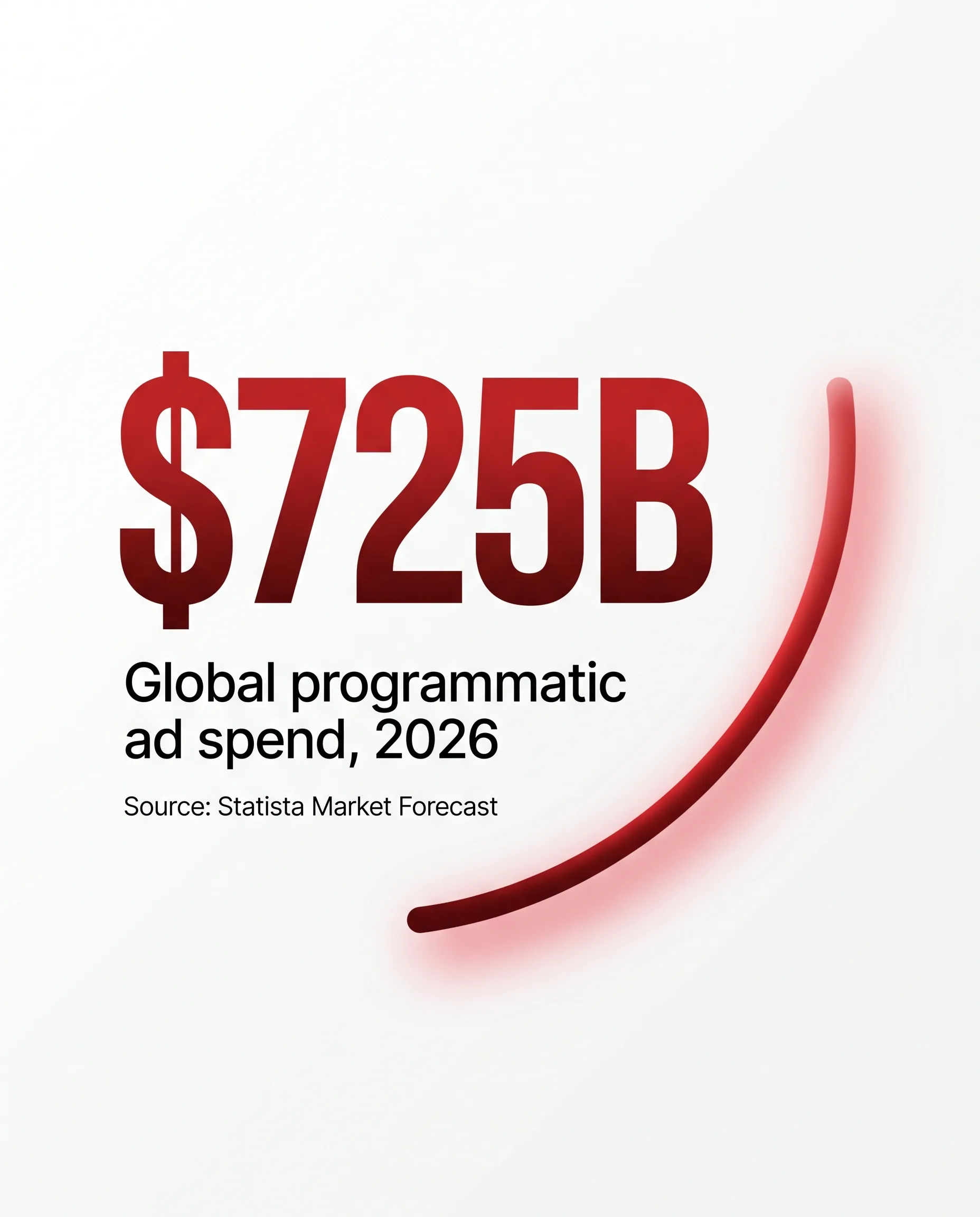
The global programmatic advertising market is projected to reach $725 billion in 2026, according to eMarketer (Statista's own comparable forecast puts the figure at a materially different level, so treat this as one research firm's estimate rather than a consensus number), and popunder remains one of the cheapest, highest-volume corners of that spend
- a handful of networks alone push a combined tens of billions of popunder impressions every single day. But "popunder ad network" is not one undifferentiated commodity: minimum CPM floors range from roughly $0.10 to $4+ depending on GEO and network, frequency-cap controls vary from a fixed default to fully real-time, and fraud filtering ranges from basic IP blocklists to layered machine-learning detection. Picking the wrong pop ads network doesn't just mean a worse rate - it means burning budget on repeat-served users and bot traffic that never had a chance to convert.The TrafficSigma team compared the top popunder networks and pop ad platforms specifically on popunder-format mechanics - not generic multi-format overviews - pulling real minimum CPMs, frequency-cap options, and GEO counts instead of marketing copy. Below are the 10 best popunder ad networks worth testing in 2026, including where TrafficSigma's own pop/popunder inventory fits alongside them. For the underlying mechanics of how popunder traffic works for publishers and advertisers, see TrafficSigma's companion guide, Popunder Ads: What They Are, How They Work, and How to Earn From Them in 2026 - this post assumes that background and focuses purely on ranking the networks.
The seven-point bar every popunder network had to clear
There's no single "best" popunder network for every buyer - a high-budget iGaming affiliate testing five Tier-1 GEOs needs something different from a solo marketer starting with a $10 test budget in Tier-3 markets. Instead of a generic ad-network scorecard, we judged every popunder ad network and pop ads network against criteria native to the popunder format specifically:
- Minimum CPM for popunder: the actual published floor rate for popunder inventory specifically (not a blended multi-format average), since this determines how cheaply you can test a new GEO or vertical.
- Frequency-cap controls: how granular the network's popunder frequency capping is - a fixed default, a few preset options, or fully real-time adjustment - because frequency capping is the single biggest lever on both popunder CPM stability and user experience.
- GEO and device/OS targeting depth: how many countries the network delivers popunder traffic into and how granular the device/OS/carrier targeting is, since blanket-GEO popunder buys waste budget fast.
- Popunder-specific fraud filtering: whether the network runs dedicated bot/fraud detection on its popunder inventory specifically, not just a generic platform-wide disclaimer.
- Delivery quality - direct vs. redirect-chain: whether the network serves popunders through a direct ad-tag mechanism or routes through multiple redirect hops, since redirect chains add latency and let more fraud and ad-quality problems slip through.
- Minimum deposit: the real dollar figure required to open a self-serve account and start buying popunder traffic, which determines accessibility for smaller media buyers.
- Vertical fit for affiliates: whether the network actively supports high-payout verticals - iGaming, Finance/Forex, Nutra, dating, sweepstakes - rather than restricting or deprioritizing them.
This section is why the ranking below isn't a repeat of any generic "top ad networks" list - every entry was checked against these seven popunder-specific criteria, not a generic multi-format rubric.
Get iGaming traffic from TrafficSigma now!
Compare these 10 popunder networks on CPM floor and targeting depth
The TrafficSigma team buys and serves popunder traffic across this exact competitive set daily - 248+ GEOs, granular frequency-cap and fraud controls, and a pop/popunder floor built for affiliates testing new markets - which is why this popunder ad network comparison is built from the buying side, not from reading other reviews. Here's the full list before the entry-by-entry breakdown:
- TrafficSigma
- PropellerAds
- RichAds
- Adsterra
- HilltopAds
- Adcash
- Clickadu
- ExoClick
- RollerAds
- PopAds
Now let's review each popunder ad network in detail.
1. TrafficSigma
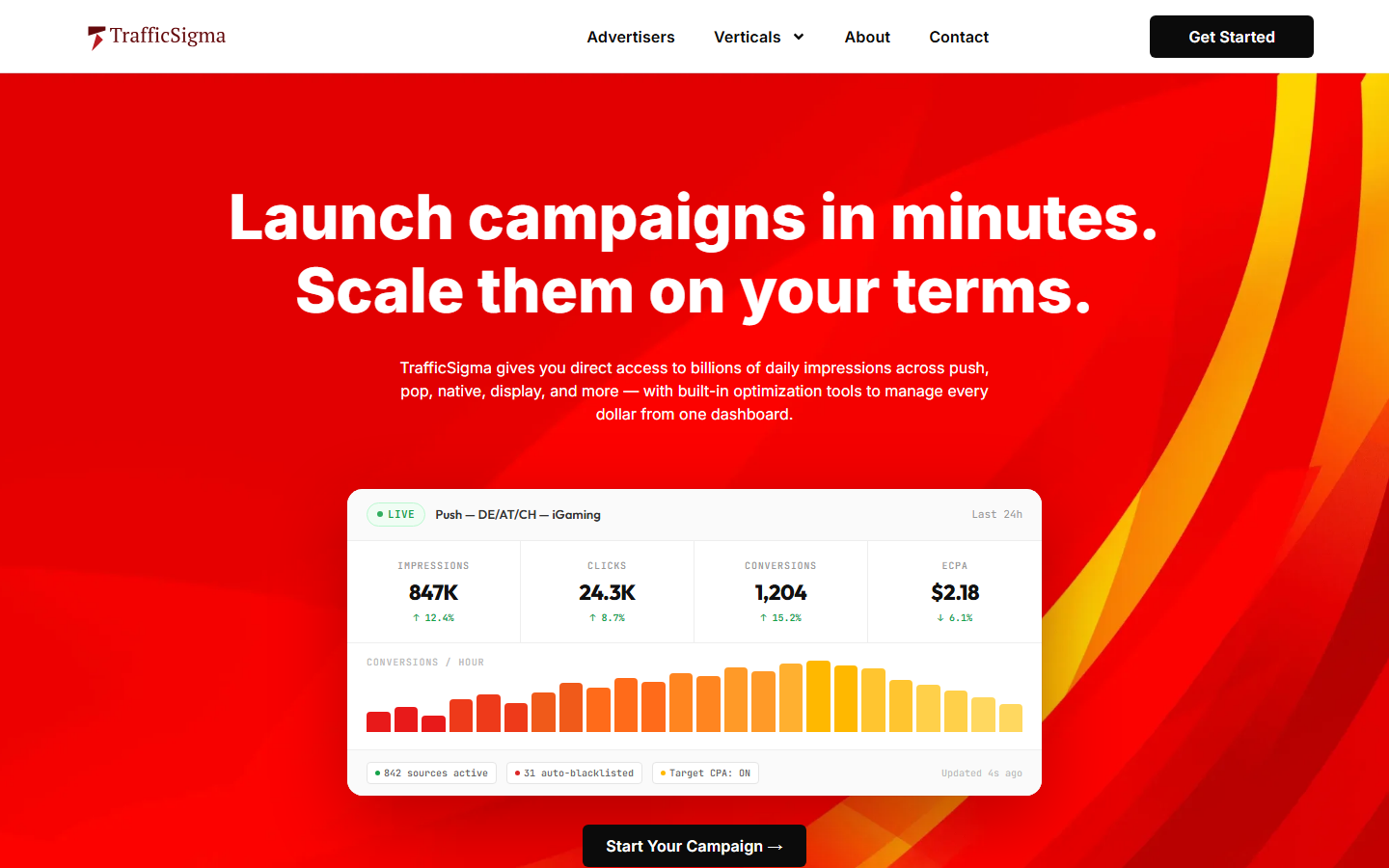
TrafficSigma is a global self-serve ad network built for performance marketers running iGaming, Finance/Forex, Nutra, dating, sweepstakes, and other high-payout verticals, with pop/popunder as one of its core traffic formats alongside push, in-page push, domain redirect, native, and Telegram Mini App ads. Popunder campaigns launch from full self-serve account access - no forced managed-service gate before a media buyer can start testing a GEO.
Pop/popunder traffic starts from $1.00 CPM, among the lower published popunder floors of any network in this comparison, with delivery across 248+ GEOs and granular GEO, device, OS, and carrier-level targeting for frequency-cap and audience control. The platform serves 4B+ daily pop impressions, and layers Micro Bidding, Target CPA, and Performance Mode on top of manual bidding so a buyer can automate optimization instead of adjusting bids by hand across every GEO.
Popunder campaigns are backed by 3-level fraud protection and vetted premium sources rather than a single generic filter, which matters most for the exact verticals TrafficSigma leans into - iGaming and Finance/Forex traffic gets targeted by bot and click-fraud activity industry-wide, so filtering at the source rather than after the click protects budget instead of just reporting on it after the spend is gone.
Highlights:
- Type/Category: Multi-format self-serve network with dedicated pop/popunder inventory
- Minimum CPM: $1.00 (pop/popunder)
- Frequency-Cap Controls: Granular GEO/device/OS/carrier targeting with Micro Bidding and Target CPA optimization
- Fraud Filtering: 3-level fraud protection, vetted premium sources
- Minimum Deposit: Self-serve account, no forced managed minimum
2. PropellerAds
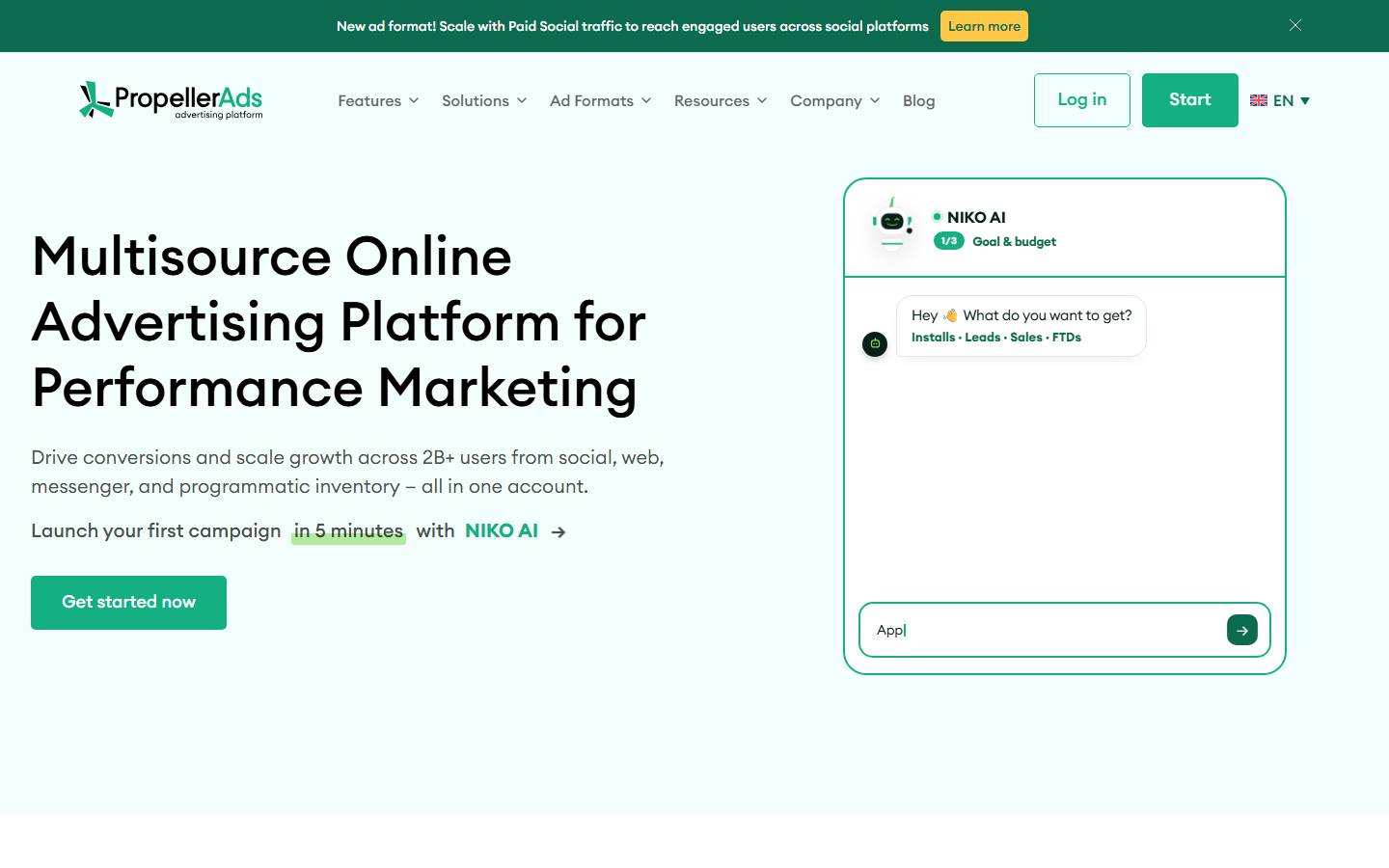
PropellerAds is a multisource self-serve advertising platform founded in 2011 and headquartered in Limassol, Cyprus, running popunder as one of its core formats alongside push, in-page push, interstitial, and native. Its popunder inventory spans 195+ GEOs, with the platform prioritizing high-volume markets like the US, Germany, France, Indonesia, Philippines, Brazil, Mexico, Nigeria, and South Africa.
Self-serve minimum deposit is $100 via card ($1,000 via wire transfer), and popunder campaigns can run on CPM, SmartCPM (automated bidding), or CPA Goal 2.0 pricing rather than flat manual bidding only. On frequency capping specifically, PropellerAds recommends starting popunder tests at 3 impressions per user per 24 hours (3:24), tightening toward a unique-only exposure setting of roughly once per two weeks (1:336) once a GEO is validated - a wider range of preset options than several competitors offer.
The SmartCPM auto-bid option reduces manual bid-tuning work for affiliates running large GEO/device-targeting matrices across dozens of popunder campaigns simultaneously, which is a genuine time-saver once a media buyer scales past a handful of test GEOs.
Highlights:
- Type/Category: Multi-format self-serve network (popunder, push, in-page push, interstitial, native)
- Minimum CPM: Variable by GEO; CPM/SmartCPM/CPA Goal 2.0 available
- Frequency-Cap Controls: Preset options from 3:24 (testing) to 1:336 (unique-only)
- Fraud Filtering: Platform-wide traffic-quality filtering across exclusive and partner inventory
- Minimum Deposit: $100 (card), $1,000 (wire)
3. RichAds
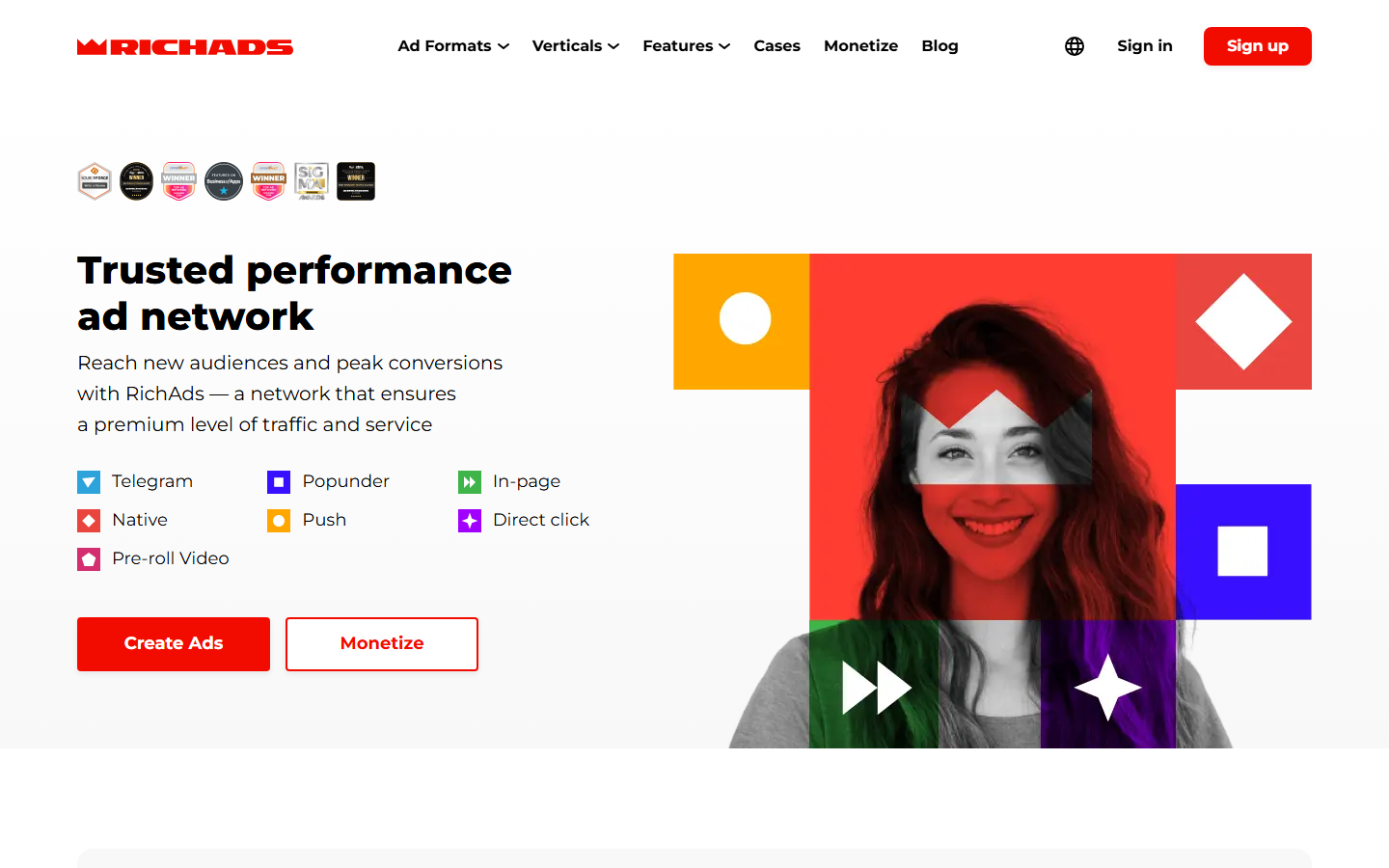
RichAds is a self-serve ad network for affiliate marketers offering popunder as one of eight traffic formats from a single dashboard, delivering roughly 5 billion daily impressions across 248+ GEOs - comparable raw scale to the largest networks in this list. It layers AI-driven bid and targeting optimization on top of manual self-serve popunder controls, aimed at affiliates who want automated optimization without losing manual override access.
Popunder/pop traffic on RichAds starts from $0.5 CPM, with rates varying by GEO the same way every network in this list prices popunder - Tier-1 markets command a premium over Tier-2/3. RichAds integrates with a range of third-party trackers (confirm the current list on their site), which matters specifically for affiliates who already run a fixed attribution stack and don't want to switch tools just to onboard a new popunder source.
RichAds pairs its self-service popunder tier with account-manager support once an advertiser deposits above a threshold, giving media buyers a path from self-serve testing to a managed relationship without switching networks entirely.
Highlights:
- Type/Category: Multi-format self-serve network (popunder, push, native, domain redirect, Telegram, calendar)
- Minimum CPM: $0.5 (pop/popunder)
- Frequency-Cap Controls: Self-serve dashboard controls with AI-assisted bid/targeting optimization
- Fraud Filtering: AI-based fraud-prevention automation
- Minimum Deposit: Self-serve account, tracker integrations included
Launch your next campaign on TrafficSigma traffic
4. Adsterra
Adsterra is a self-serve advertising network and SSP launched in 2013, delivering popunder traffic into 248 GEOs with roughly 12 billion monthly pop impressions and 45,000+ publisher partners by the company's own reporting - the broadest published GEO count of any network in this comparison. Popunder sits alongside its Social Bar and in-page push formats as core self-serve inventory.
Self-serve minimum deposit is $100 via card ($200 crypto, $1,000 wire), with a $25 minimum campaign budget on CPM/CPC pricing. Adsterra's default popunder frequency-cap setting is 4 impressions per user per 2 hours with a 10-second delay between them, though publishers and advertisers can tighten it down to a stricter 1-per-24-hours cap - giving buyers more granular control than a single fixed default.
Adsterra runs a three-level anti-fraud system plus an anti-adblock layer specifically positioned to protect popunder and display inventory from bot traffic, which is a meaningful differentiator for affiliates buying volume in GEOs where fraud rates run highest.
Highlights:
- Type/Category: Multi-format self-serve network (popunder, Social Bar, in-page push, native, banner)
- Minimum CPM: $25 minimum CPM/CPC campaign budget
- Frequency-Cap Controls: Default 4/2h (10s delay), adjustable down to 1/24h
- Fraud Filtering: Three-level anti-fraud system plus anti-adblock
- Minimum Deposit: $100 (card)
5. HilltopAds
HilltopAds is a popunder-focused ad network operating since the early 2010s (sources differ on the exact founding year), delivering more than 273 billion monthly ad impressions across popunder, in-page push, and video formats from a large base of direct publishers - among the highest raw monthly impression counts in this comparison. It positions itself specifically around popunder scale rather than a broad multi-format catalog.
Self-serve minimum deposit is $100, and popunder frequency capping is configurable down to granular windows such as once per 12 hours (1/12h), giving advertisers finer-grained control over repeat-impression exposure than a flat daily cap alone would allow. Pricing runs CPM-based across popunder, in-page, and video inventory.
For advertisers prioritizing raw popunder volume above format breadth, HilltopAds' publisher-direct inventory base is the clearest differentiator versus multi-format networks that split traffic across five or six formats simultaneously.
Highlights:
- Type/Category: Popunder-focused self-serve network (popunder, in-page push, video)
- Minimum CPM: Variable by GEO, CPM-based pricing
- Frequency-Cap Controls: Configurable down to 1/12h windows
- Fraud Filtering: Direct-publisher inventory base with platform traffic-quality checks
- Minimum Deposit: $100
How to Buy Website Traffic Without Buying Bots: A 2026 Buyer's Guide. Frequency-cap discipline only solves part of the fraud problem - the other part is filtering bot and click-fraud traffic before it ever burns budget. TrafficSigma's guide breaks down the traffic-quality checks every network in this comparison should be running, and how to spot a network that only pays lip service to fraud protection. Continue reading.
6. Adcash
Adcash is a self-serve DSP founded in 2007 and headquartered in Tallinn, Estonia, making it one of the longest-running popunder networks still actively used by affiliates. Popunder sits alongside native, banner, autotag, interstitial, and in-page push formats, with delivery into 195+ GEOs.
Self-serve minimum deposit is $100 (versus $1,000 on Adcash's separate managed-service tier), and Tier-1 popunder CPMs (US, UK, Canada, Australia) run roughly in the low single dollars, with Tier-3 markets falling to well under $1 CPM - published bands aren't officially confirmed, but the spread is wide enough that GEO selection matters more on Adcash than on flatter-priced networks. Frequency capping is configurable, with a 1-per-24-hours setting as a common baseline advertisers apply to popunder campaigns.
Adcash's "SmartTag" auto-tag technology automatically rotates ad formats within a single placement, which can lift effective popunder fill rate without an advertiser manually testing each format themselves - a useful automation layer for buyers managing many placements at once.
Highlights:
- Type/Category: Multi-format self-serve DSP (popunder, native, banner, interstitial, in-page push)
- Minimum CPM: low single dollars (Tier-1), under $1 (Tier-3) - unconfirmed published bands
- Frequency-Cap Controls: Configurable, 1/24h common baseline
- Fraud Filtering: Platform-wide traffic-quality filtering
- Minimum Deposit: $100 (self-serve tier)
Start scaling your campaigns with TrafficSigma
7. Clickadu
Clickadu is a self-serve ad network established in the early-to-mid 2010s (sources commonly cite 2014), delivering 6 billion+ daily impressions and reaching more than 3 billion people monthly across popunder, push, in-page, and instant-text-message formats, with over 3,000 active publishers feeding its popunder inventory. Top GEOs include Vietnam, Indonesia, Brazil, the US, Germany, France, and Thailand.
Self-serve minimum deposit is $100, accepted via wire transfer, Paxum, PayPal, Webmoney, or card, and popunder CPMs on Clickadu can reach up to $4 in premium GEOs, with rates otherwise scaling by format, geography, and traffic quality the same way every network in this list prices popunder. Clickadu has invested specifically in machine-learning-based anti-fraud detection that continuously monitors campaigns to filter bot traffic and fraudulent clicks in real time, rather than relying on static blocklists alone.
That ML-based, continuous-monitoring approach to fraud filtering is Clickadu's clearest differentiator versus networks that only run a one-time traffic-quality check at onboarding.
Highlights:
- Type/Category: Multi-format self-serve network (popunder, banner, push, in-page, instant text message)
- Minimum CPM: Up to $4 in premium GEOs; variable by format/GEO
- Frequency-Cap Controls: Self-serve dashboard controls
- Fraud Filtering: Machine-learning-based, continuous campaign monitoring
- Minimum Deposit: $100
8. ExoClick

ExoClick is a self-serve ad network founded in 2006 and headquartered in Barcelona, Spain, making it one of the oldest continuously operating popunder networks in this comparison, with broad GEO monetization across essentially every country it serves rather than leaving unsold impressions in smaller GEOs.
Self-serve minimum deposit is $200, and ExoClick's published popunder CPM tiers run roughly $0.5 (Tier-1), $0.3 (Tier-2), and $0.1 (Tier-3) - a straightforward three-tier structure that's easier to plan a test budget around than a network with dozens of individually priced GEOs.
ExoClick's near two-decade operating history is a genuine differentiator for affiliates who weight platform longevity as a signal of reliability when choosing where to route ongoing popunder spend.
Highlights:
- Type/Category: Multi-format self-serve network with dedicated popunder tier pricing
- Minimum CPM: ~$0.5 (Tier-1), ~$0.3 (Tier-2), ~$0.1 (Tier-3)
- Frequency-Cap Controls: Self-serve dashboard controls
- Fraud Filtering: Platform-wide traffic-quality filtering
- Minimum Deposit: $200
9. RollerAds
RollerAds is a push-and-popunder network founded around 2019 that rebranded its popunder format as "OnClick" traffic, delivering more than 7 billion daily impressions across 200+ GEOs to over 20,000 direct publishers and 60,000 advertisers. As one of the newer networks in this comparison, it leans on aggressive minimums to attract smaller test budgets.
Minimum deposit is $50 - among the lowest of any network reviewed here - with a minimum CPM of $0.5, putting RollerAds within easy reach of affiliates who want to test a new GEO or vertical without committing a large budget upfront. Self-serve dashboard controls cover standard GEO/device targeting for OnClick/popunder campaigns.
RollerAds' combination of a $50 minimum deposit and sub-$1 CPM floor makes it one of the more accessible popunder networks in this list for affiliates running a first test campaign before scaling spend elsewhere.
Highlights:
- Type/Category: Push-and-popunder self-serve network (OnClick/popunder format)
- Minimum CPM: $0.5
- Frequency-Cap Controls: Self-serve dashboard GEO/device targeting
- Fraud Filtering: Platform-wide traffic-quality filtering
- Minimum Deposit: $50
See TrafficSigma pricing and ad formats
10. PopAds
PopAds is a popunder-only ad network founded in 2010, fully focused on pop traffic rather than splitting inventory across multiple formats - one of the longest-running networks dedicated exclusively to popunder in this comparison. It offers real-time targeting and bidding adjustments purpose-built for a pop-only buying workflow.
Minimum deposit is just $10, and minimum bid starts at $0.0001 per view (roughly $0.10 CPM) - the lowest published entry point of any network reviewed here, though competitive GEOs require bidding meaningfully above that floor to win real volume. Advertisers can adjust frequency caps, ad types, and targeting in real time rather than only at campaign setup, and publisher payouts process daily with a $5 minimum withdrawal via PayPal.
PopAds' popunder-only focus and real-time control panel make it a natural fit for affiliates who want to iterate on frequency caps and targeting mid-campaign rather than waiting for the next optimization window.
Highlights:
- Type/Category: Popunder-only self-serve network
- Minimum CPM: ~$0.10 (minimum bid), rising with GEO competitiveness
- Frequency-Cap Controls: Real-time adjustment
- Fraud Filtering: Platform-wide traffic-quality filtering
- Minimum Deposit: $10
CPM floor, frequency caps, and fraud filtering: 10 popunder networks compared
Popunder networks can look interchangeable from the outside - most claim broad GEO coverage and "competitive" rates - but minimum CPMs, frequency-cap granularity, and deposit thresholds differ a lot once you check the actual published numbers. Use this table as the fast reference; every figure already appeared in the entry above it.
| Network | Minimum CPM | Frequency-Cap Controls | Fraud Filtering | Minimum Deposit | Best For |
|---|---|---|---|---|---|
| TrafficSigma | $1.00 | Granular GEO/device/OS/carrier + Micro Bidding | 3-level fraud protection | Self-serve, no forced minimum | High-payout verticals (iGaming, Finance/Forex, Nutra) wanting a low CPM floor |
| PropellerAds | Variable; SmartCPM/CPA Goal 2.0 | Presets 3:24 to 1:336 | Platform-wide filtering | $100 (card) | Affiliates wanting automated SmartCPM bidding |
| RichAds | $0.5 | Self-serve + AI-assisted optimization | AI-based fraud prevention | Self-serve account | Buyers wanting AI bid automation with tracker integrations |
| Adsterra | $25 min campaign budget | Default 4/2h, adjustable to 1/24h | Three-level anti-fraud + anti-adblock | $100 (card) | Broadest GEO reach (248 countries) |
| HilltopAds | Variable by GEO | Configurable to 1/12h | Direct-publisher inventory checks | $100 | Highest raw monthly impression volume |
| Adcash | Low single dollars (T1), under $1 (T3) - unconfirmed bands | Configurable, 1/24h baseline | Platform-wide filtering | $100 | Longest operating history (since 2007) |
| Clickadu | Up to $4 (premium GEOs) | Self-serve dashboard | ML-based, continuous monitoring | $100 | Buyers prioritizing active fraud monitoring |
| ExoClick | $0.5 (T1), $0.3 (T2), $0.1 (T3) | Self-serve dashboard | Platform-wide filtering | $200 | Simple three-tier CPM planning |
| RollerAds | $0.5 | Self-serve dashboard | Platform-wide filtering | $50 | Lowest-budget first test campaigns |
| PopAds | ~$0.10 (min bid) | Real-time adjustment | Platform-wide filtering | $10 | Popunder-only buyers wanting mid-campaign control |
Which popunder ad network should you pick?
The right popunder network depends on which of this guide's criteria matters most for your campaign: your minimum CPM tolerance, how granular a frequency cap you need to protect user experience and CPM stability, and how much fraud filtering your vertical requires. Affiliates running iGaming, Finance/Forex, or Nutra offers - verticals that draw disproportionate bot and fraud activity - should weight fraud filtering and GEO/device targeting depth above a marginally lower CPM; affiliates just starting out should weight minimum deposit and CPM floor first, since a $10-$50 entry point lets you test a GEO before committing real budget.
Whichever network you start with, the setup work is the same: pick a GEO, set a conservative frequency cap, and scale only what the conversion data actually supports. That's exactly the workflow TrafficSigma's own pop/popunder inventory is built around - a $1.00 CPM floor, 248+ GEOs, granular GEO/device/OS/carrier targeting, and 3-level fraud protection, so a first test campaign and a scaled one run on the same controls rather than requiring a network switch in between.