The global advertising market is on pace to hit $1.26 trillion in 2026, with roughly 69% of that spend now digital, according to Statista's Market Forecast - and inside that digital slice, eMarketer projects overall programmatic advertising spend (not display specifically) to reach around $725 billion in 2026. Popunder ads are one of the oldest, cheapest-to-scale corners of that programmatic display world, and one of the most misunderstood: most media buyers can describe a pop-up, but far fewer can explain what actually makes a popunder different, how a publisher gets paid for one, or how to launch a popunder campaign that converts instead of just annoying users.
The TrafficSigma team analyzed how popunder traffic works end-to-end - from the browser-level mechanics through the publisher payout model to the advertiser buying process - so both sides of the market can use it correctly. This guide breaks down what popunder ads are, how popunder traffic advertising works for publishers and advertisers, where to buy popunder traffic (and what to look for in a pop ads network before you do), real popunder CPM benchmarks by GEO, and where pop traffic still earns a place in a 2026 media plan.
The framework: three things you need to understand about popunder ads
There's no single "right" way to think about popunder ads - it depends on which seat you're sitting in. A publisher cares about frequency caps and payout rates; an advertiser cares about GEO targeting and creative approval; a compliance team cares about browser policy and ad-quality standards. Rather than treating popunder as one monolithic topic, this guide organizes it around the three models that actually structure the format:
- The mechanical model: what a popunder ad literally does at the browser level, and why that mechanism is what separates it from a pop-up or a direct-link/direct-click ad.
- The publisher earning model: how a site owner turns popunder inventory into CPM revenue, and why frequency capping is the single biggest lever on that revenue.
- The advertiser buying model: how a media buyer sources popunder traffic, targets it by GEO/device/OS, and sets it up to convert instead of just generating impressions.
Every section below maps to one of these three models, plus a terminology-clarification segment (popunder vs. pop-up vs. direct click) and a compliance segment on frequency caps and browser/platform policy - the two areas where most confusion, and most policy risk, actually live.
What is a popunder? How popunder ads work mechanically
A popunder is a browser window or tab that opens behind the page a user is actively viewing, triggered by a click anywhere on the host page - a button, a banner, a video player, even a blank area of the layout - or, less commonly, by a script that fires on page load. Because the new window opens underneath the active one rather than in front of it, the user doesn't see it immediately. They only encounter the popunder ad when they close, minimize, or switch away from their current tab - at which point the advertiser's landing page is sitting there, already loaded, waiting for a few seconds of unforced attention. This is the core mechanical answer to "what is popunder": it's a same-click, background-tab ad delivery method, not an interruption format.
That single mechanical difference - behind versus in front - is why popunder inventory built a durable market for two decades: the ad doesn't block the content the user came for, so it doesn't get closed on reflex the way a pop-up does. It also means popunder ads work the same way whether the trigger is a native site element (a "play" button, a download link) or an ad tag inserted specifically to fire the popunder - which is why "popunder traffic advertising" is sold as its own inventory type by pop-focused ad networks rather than bundled generically into "display."
Modern browsers complicate the pure window.open() version of this mechanic. Chrome and other major browsers have shipped native pop-up-blocking logic for years, and Chrome specifically targeted "tab-under" behavior - a script silently swapping the current tab's content while opening a new one in the background - starting around 2017, with broader "abusive experience" blocking following in Chrome 71. That's why popunder delivery today typically routes through JS-based tab-opening mechanics and ad-network SDKs tuned to browser policy, rather than the raw script tags that worked a decade ago. A popunder example in 2026 is far more likely to be served through a vetted ad network's tag than a raw window.open() call a site owner wrote themselves - which is also the practical reason most publishers route popunder monetization through a network instead of self-serving it.
Popunder vs. pop-up vs. direct click: the terminology that trips people up
"Popup/popunder traffic" gets used as one phrase constantly, but the three related terms describe three different user experiences, and mixing them up leads to the wrong targeting and creative decisions:
- Pop-up: opens in front of the page the user is viewing, forcing an interaction (usually a close click) before they can continue. This is the classically disruptive format and the one most ad-quality standards explicitly restrict.
- Popunder: opens behind the active window, as described above. Because the user isn't interrupted mid-task, popunder traffic generally produces calmer, less-forced engagement than pop-up traffic, and most pop-focused networks report advertisers seeing stronger results from popunder placements for exactly that reason.
- Direct click (sometimes called direct link): no separate window at all - clicking a page element (or, on some networks, any point on the page) sends the user's current tab straight to the advertiser's landing page. There's no "behind" or "in front"; the user's own tab simply navigates. Direct click is the simplest and lowest-friction format of the three, but it also fully replaces the page the user was on, which is a different UX trade-off than either pop format.
Advertisers researching "popunder ads examples" often find creative from all three formats mixed together in screenshots, because the landing pages themselves can look identical - the difference is entirely in how the tab/window got there, not in the creative on the page.
The publisher earning model: how site owners make money with popunder ads
For publishers, popunder is one of the simplest inventory types to monetize because it doesn't require a dedicated ad slot in the page layout - it monetizes a click or a page load, not a banner position. The standard model is straightforward:
- The publisher (any site owner - a streaming, download, gaming, or utility site, most commonly) integrates a popunder tag from an ad network.
- Every qualifying user action (per the network's rules - typically the first click on the page within a capped window) triggers a popunder ad to load behind the active tab.
- The publisher gets paid CPM - a rate per 1,000 popunder impressions actually served - with the network taking a share and passing the rest through as publisher payout.
The one variable that determines whether that CPM stays high or collapses is frequency capping. Ad-quality case studies from pop-focused networks consistently point to one popunder impression per unique visitor per 24 hours ("1/24") as the industry-standard cap: it's the ceiling that keeps per-impression value high and keeps the user experience light enough that visitors keep coming back. Publishers who push caps higher - 3/24 or 5/24 - can generate more raw impression volume from the same traffic, but each individual impression tends to sell for less, and repeat-visitor engagement typically degrades faster, which is why 1/24 remains the default recommendation across the format. Getting this cap right is genuinely more important to a publisher's long-run popunder revenue than almost any other single setting.
It's also worth publishers knowing where they can't run popunder inventory at all: Google's AdSense policy explicitly states that a site cannot run AdSense ads if the site "contains or triggers pop-unders," regardless of whose ad is doing the triggering - a direct, quotable policy line from Google's own AdSense blog. That doesn't ban popunder monetization outright; it means a publisher has to choose a lane - AdSense-compliant display, or a dedicated pop/popunder network - rather than blending the two on the same page.
For publishers and media buyers who already understand the frequency-capping fundamentals above and want the next level of detail - how to raise volume without eroding CPM, and how to avoid the most common popunder ads how to earn mistakes.
Get pop/popunder traffic from $1.00 CPM with TrafficSigma!The advertiser buying model: how media buyers launch popunder campaigns
On the buying side, if you want to buy popunder traffic, the process looks the same as most performance-format media buying: a self-serve dashboard, GEO/device/OS targeting, a bid or CPM rate, and a frequency cap, then daily optimization against conversion data. What makes pop traffic specifically attractive to performance media buyers is the combination of scale and cost: because the ad loads without competing for a visible ad slot, popunder inventory is abundant and - outside a handful of premium GEOs - cheap relative to most display formats.
Not every pop ads network is built the same way, though. A pop up ads network that only exposes a flat CPM bid and no targeting depth will burn budget on irrelevant GEOs and devices; a stronger popup ad network exposes granular controls - GEO, device, OS, carrier, and frequency cap - plus fraud filtering, so the same nominal CPM actually converts. That gap in tooling, more than any difference in raw traffic volume, is what separates networks worth testing from ones to avoid.
This is exactly the model TrafficSigma's own popunder and domain-redirect inventory is built around: pop/popunder traffic starting from $1.00 CPM, served across 248+ GEOs with granular GEO, device, OS, and carrier-level targeting, plus Micro Bidding and Target CPA tools that let a buyer optimize spend toward actual conversions instead of guessing at a flat bid. Frequency-cap controls and three-level fraud protection sit on top of that targeting layer specifically so popunder volume doesn't get wasted on the same handful of over-served users or on non-human traffic - a real risk in any inventory type sold on raw impression volume.
Popunder traffic advertising over-indexes with a specific set of verticals, and the pattern is consistent across pop-focused ad networks' own vertical breakdowns: iGaming and betting are repeatedly named as the strongest-performing category for popunder, thanks to a cold-to-warm funnel that suits an unexpected background tab landing on an offer; dating converts fast on the same logic; antivirus, VPN, and utility/software offers are cited as consistently strong performers; and sweepstakes and Nutra (particularly in Tier-2/Tier-3 GEOs with localized creative) round out the format's best-fit categories. If you're planning where popunder traffic advertising earns its budget, start with those verticals before testing further afield.
Real popunder CPM benchmarks by GEO (industry rate-card and blog-published ranges, not audited analyst figures - treat as general market context, not a guaranteed rate):
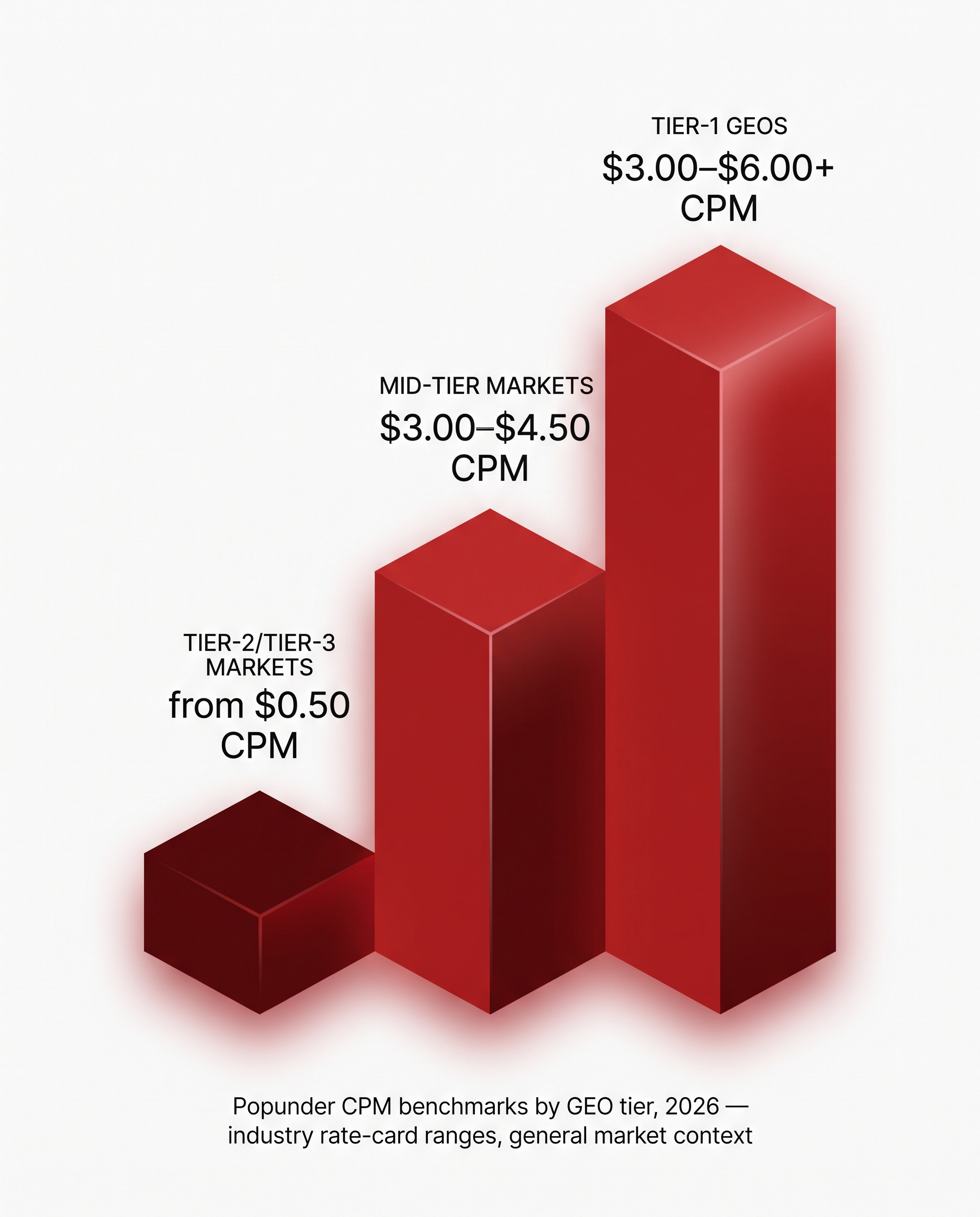
- Tier-1 (US, UK, Canada, Germany, Australia): roughly $3.00–$6.00+ CPM, with premium placements occasionally reaching $10.
- Mid-tier markets: roughly $3.00–$4.50 CPM.
- Tier-2/Tier-3 markets: CPMs fall sharply, with broad availability starting from around $0.50 CPM.
Those ranges represent the open pop-ad market broadly, gathered from multiple ad-network rate cards and blogs - actual popunder CPM on any specific campaign depends heavily on GEO, device mix, targeting precision, and creative-to-offer fit. TrafficSigma's own published floor for pop/popunder traffic is $1.00 CPM, positioned at the accessible end of that broader market range so smaller budgets can still test GEOs before scaling.
Start scaling your campaigns with TrafficSigma
Compliance and frequency-cap best practices for popunder ads
Popunder sits in an unusual regulatory position: it's disliked by users in roughly the same way pop-ups are, but it isn't named as its own category in the most widely cited ad-quality standard. The Coalition for Better Ads' Better Ads Standards - the industry benchmark built from large-scale consumer testing - explicitly names pop-up ads (desktop and mobile) as a disqualified experience type. Popunders sit adjacent to that finding in spirit, but the Coalition's public standards documentation doesn't carry a separately named popunder rule, so treat popunder as "in the same disruptive-format conversation as pop-ups" rather than "explicitly banned by the same named standard."
What does carry direct, sourceable weight is browser and platform policy:
- Chrome and other major browsers actively block "tab-under" behavior - a script that silently opens a new background tab while hijacking the current one - a policy Chrome began rolling out around 2017 and expanded under its broader "abusive experiences" enforcement in Chrome 71. This is the main reason popunder delivery today runs through vetted ad-network tags rather than raw legacy scripts.
- Google's AdSense policy bars any site that triggers pop-unders from running AdSense at all, as covered above - a hard line publishers need to plan around, not a gray area.
- No IAB-specific popunder standard exists publicly, so the practical compliance bar for both publishers and advertisers comes down to three levers: frequency capping (1/24 as the accepted norm), GEO/device targeting precision (so volume goes to relevant, receptive users instead of blanket-blasting), and fraud/quality filtering (so paid impressions are real human traffic, not bot-inflated volume). Networks that build all three into the buying and publisher dashboards - rather than leaving them to manual configuration - are the ones that keep popunder viable as a format instead of letting it degrade into the low-quality reputation it's fought for years. For a deeper look at how fraud filtering specifically protects popunder and other high-volume ad spend, see TrafficSigma's How to Buy Website Traffic Without Buying Bots: A 2026 Buyer's Guide.
See TrafficSigma pricing and ad formats
Popunder, pop-up, and direct click: CPM and buyer fit at a glance
Reading the three formats side by side makes the practical differences easier to apply when you're deciding what to buy or what to run as a publisher.
| Format | Where it opens | User interruption level | Typical buyer | Typical CPM range (2026, industry-published) |
|---|---|---|---|---|
| Popunder | Behind the active tab | Low - seen only when user switches/closes tabs | iGaming, dating, VPN, antivirus/utilities, sweepstakes, Nutra | $0.50–$6.00+ (GEO-dependent; TrafficSigma floor $1.00 CPM) |
| Pop-up | In front of the active tab, forcing interaction | High - blocks content until closed | Legacy display/affiliate offers; increasingly restricted by browsers and ad-quality standards | Comparable gross CPM to popunder in raw terms, but heavily blocked/filtered by modern browsers, reducing effective delivered volume |
| Direct click / direct link | Replaces the current tab entirely | Medium - no popup window, but the original page is gone | Performance offers prioritizing lowest friction (subscriptions, downloads, sign-ups) | Typically sold as CPC rather than CPM; not directly comparable on a CPM basis |
Every figure in this table already appears in the sections above - use it as the fast reference, not as a new data source.
Is popunder still worth running in 2026?
Popunder ads earn their place in a 2026 media plan for the same reason they've survived two decades of ad-format churn: the mechanic itself - loading behind the active tab instead of in front of it - sidesteps the instant-close reflex that kills pop-up performance, while still delivering a real, unforced few seconds of landing-page attention. The three things that actually determine whether a popunder campaign or publisher integration performs are the same three this guide walked through: getting the frequency cap right (1/24 as the accepted norm), targeting the GEOs and verticals where popunder converts best (iGaming, dating, VPN, antivirus/utilities, sweepstakes, and Nutra lead the list), and buying or serving through a network that handles fraud filtering and browser-policy compliance for you instead of leaving it to a raw script tag.
That's the exact gap TrafficSigma's popunder and domain-redirect inventory is built to close: pop/popunder traffic from $1.00 CPM, across 248+ GEOs, with the GEO/device/OS targeting, frequency-cap controls, and fraud protection that turn popunder from a blunt-volume format into a controllable performance channel. Whether you're a publisher deciding on a frequency cap or a media buyer testing a first popunder GEO, the setup work is the same either way - start small, cap aggressively, and scale what the data actually supports.